

- 10 min read
Calendar Based Budgeting App: Plan Your Cash Flow by Date and Never Miss a Bill
Most budgets fail because they ignore dates. A calendar based budgeting app maps every paycheck, bill, and spending block to the day it happens, so you never get caught short again.
Here's the problem: Nearly two-thirds of U.S. adults (64%) live paycheck to paycheck, and 40% say they regularly incur late fees, highlighting how timing gaps between income and bills drive financial stress rather than total income alone (PwC). The typical U.S. household paid an average of $132 per year in overdraft fees even after pandemic-era reductions, showing the real cost of not aligning cash flow to due dates (CFPB).
What You'll Learn and Why It Matters
In this guide, you'll discover:
- How a calendar based budgeting app works and why it helps prevent overdrafts
- The must-have features of a visual calendar budget tool
- A 30-minute, step-by-step setup to budget by date
- Which apps to try, how they compare, and how to choose
This matters because aligning income, bills, and spending to actual dates fixes the real problem: cash-flow timing gaps. This approach works especially well with irregular income, debt payoff, and managing many due dates.
Ready to see your money by date? Start your free trial of a drag-and-drop calendar budgeting app now, or grab the free budget calendar template to get started.
Sources:
What Is a Calendar Based Budgeting App?
A budget by calendar app places paychecks, bills, and expenses on a month view. You see your projected bank balance by day and can move items to avoid dips (PocketSmith).
Unlike list-based budgets, a visual calendar budget focuses on timing, not just monthly totals. Financial educators note that most people mentally organize their money by dates (paydays, rent due, card due dates), and that calendar-based finance apps leverage this familiarity to make budgeting more intuitive than list-based systems (Rob Berger).
Who It's For
Calendar budgeting works best for people with:
- Weekly or biweekly pay schedules
- Gig or freelance income
- Students managing financial aid and part-time work
- Families juggling multiple due dates
Outcomes You Can Expect
With consistent use, you can expect:
- Fewer overdrafts and late fees
- Clearer paycheck-to-paycheck planning
- Faster debt payoff by prioritizing due-date order
See how drag-and-drop calendar scheduling shows daily projected balances in real-time. Start your free trial to experience the difference.
Sources:
How a Visual Calendar Budget Prevents Cash Shortfalls
Timing Beats Totals
Here's a common scenario: Your monthly budget looks "balanced" on paper, but your account still dips negative from the 1st through the 10th before payday hits. Calendar planning exposes these gaps that traditional budgets miss.
The CFPB finds that many overdrafts occur within a few days of paychecks when multiple automatic payments hit together, indicating that misaligned payment timing drives negative balances, not just overspending (CFPB).
Paycheck Planning and Bill Batching
A calendar view lets you assign which paycheck covers which bills. You can move flexible spending like groceries and gas to safer dates, keeping your daily balance above zero.
Projected Balance Line
Calendar-style budget tools that forecast balances "every single day" enable users to drag and drop expenses to different dates and immediately see the impact on future cash flow, helping them proactively prevent shortfalls (PocketSmith).
Sources:
Must-Have Features in a Calendar Budget Planner (Buyer's Checklist)
Calendar-First Experience
Look for drag-and-drop transactions by date, recurring rules with skip and holiday options, and instant projected balance updates. Leading calendar budgeting tools emphasize this real-time scheduling so users can "see their future bank balance at a glance" and test different timing scenarios (CalendarBudget).
Paycheck and Income Scheduling
The app should support weekly, biweekly, and irregular pay cycles. It should handle variable income targets and let you earmark specific dollars to specific bills.
Projected Balances and Cash Flow Alerts
Daily running balance calculations are essential. Low-balance and due-date notifications help reduce overdraft incidence. Consumer banking research stresses the value of proactive alerts: the CFPB reports that balance and due-date alerts can significantly reduce overdraft incidence by warning consumers before they dip below zero (CFPB).
Sinking Funds and Envelopes by Date
The ability to allocate monthly contributions toward upcoming non-monthly expenses like insurance and holiday spending saves you from scrambling when big bills hit.
Debt Payoff Scheduling
Track due dates, model extra payments, and support both snowball and avalanche methods directly on the calendar.
Bank Sync and Manual Mode
Choose between secure read-only bank connections or manual-only entry. Quick reconcile tools help you stay current either way.
Shared Budgets and Permissions
Partner access, comments, and activity logs keep household budgets coordinated without conflicts.
Cross-Platform and Calendar Integrations
iOS, Android, and web access plus the ability to export to Google or Apple Calendar ensures you can check your budget anywhere.
Security and Privacy Standards
Look for read-only data aggregation, encryption, multi-factor authentication, and clear data deletion policies.
Pricing and Value
Most calendar budget apps range from free basic versions to $5-15 monthly for premium features like alerts, multiple accounts, and shared access.
Try a drag-and-drop calendar with projected balance line free for 14 days to see if the interface works for your planning style.
Sources:
30-Minute Setup: Budget by Calendar App Step-by-Step
Prep (5 minutes)
Gather your next two pay dates, current account balances, fixed bills with due dates, and typical flexible spending amounts. Financial planners commonly recommend starting with a simple inventory of fixed bills, pay dates, and typical variable expenses as the first step to any effective budget, because visibility into fixed obligations anchors all later adjustments (Consumer.gov).
Add Accounts and Set Starting Balance (5 minutes)
Choose bank sync (read-only connection) or manual entry. Confirm your current balances are accurate in the app.
Schedule Income (5 minutes)
Enter your paychecks with expected amounts and sources. Map out the recurrence pattern (weekly, biweekly, or custom dates).
Add Bills and Subscriptions (5-10 minutes)
Input due dates, amounts, and recurrence for all fixed expenses. Include minimum debt payments in this step.
Plan Flexible Spending by Date (5 minutes)
Place groceries, gas, and discretionary spending near paydays. Set weekly caps to prevent overspending.
Review Projected Balance and Resolve Dips (5 minutes)
Look for days when your balance goes negative. Reposition flexible items, split large bills across paychecks, or add small buffer amounts.
Pro Tips
- Create a "Month Start Buffer" line item for unexpected expenses
- Color-code must-pay versus flexible expenses
- Turn on reminders 3-5 days before due dates
Zero-based and envelope-style budgeting guidance stresses giving every dollar a job and assigning expenses to specific paychecks, which dovetails directly with scheduling each bill and spending block to concrete dates in a calendar tool (YNAB).
Sources:
Playbooks for Common Situations
Irregular or Seasonal Income
Budget from a conservative base income estimate. Set aside variable income in a separate buffer. Build at least a two-week cash cushion. Use extra income for sinking funds and debt acceleration.
Households with irregular income are advised by financial educators to build at least one month of essential expenses as a buffer and to budget based on a conservative income estimate, using "extra" income to accelerate savings and debt payoff (CFPB).
Debt Payoff Acceleration
Schedule minimum payments by their due dates first. Place snowball or avalanche extra payments right after a paycheck hits. Use the calendar to simulate different payoff dates.
Big Annual or Quarterly Bills
Create monthly sinking fund contributions. Auto-split the total cost across paychecks leading up to the target date.
Shared Household Budgeting
Assign owners to different categories and bills. Set up shared access rules. Schedule weekly 10-minute calendar check-ins to stay coordinated.
Use paycheck assignment features to lock in these strategies from day one. Start your free trial to test these workflows.
Best Calendar Based Budgeting Apps to Try in 2026
Note: App capabilities evolve frequently. Verify current features and pricing before committing.
Dollarbird - Strong Visual Calendar Budget with Collaborative Features
Dollarbird positions itself as a "collaborative smart calendar for your finances" with automatic balance forecasting and shared calendars (Dollarbird).
Pros: Calendar-native interface, projected balances, shared budgets. Best for couples and visual planners.
CalendarBudget - Focused Calendar Budget Planner for Bills and Cash Flow
CalendarBudget markets its ability to forecast future account balances, visualize cash flow by date, and help users avoid overdraft fees (CalendarBudget).
Pros: Robust recurring scheduling, reminders, web and mobile access. Best for bill-heavy households needing date-driven clarity.
General Budgeting Apps with Calendar Views
Popular apps like YNAB, EveryDollar, Monarch, and Simplifi offer some calendar features. Check whether they're truly calendar-first or just reminder-focused. Verify projected balance accuracy and paycheck assignment capabilities.
Reviews of top budgeting apps by major outlets emphasize matching tools to complexity. Apps like YNAB and Monarch are recommended for multi-income, goal-heavy households, while simpler apps suit single-income or basic needs (NerdWallet).
Free vs Paid Options
Paid tiers often add alerts, multiple accounts, shared access, and bank sync. Avoid a single overdraft fee and the app can pay for itself multiple times over.
Want drag-and-drop scheduling by date plus projected balances? Try a free trial to compare interfaces side-by-side.
Sources:
How to Choose the Right Calendar Based Budgeting App: Quick Decision Guide
Match to Your Pay Cycle and Complexity
Multiple income sources, side gigs, and shared budgets need strong scheduling capabilities, envelope features, and user permissions. Simple situations can work with basic calendar tools.
Do a 14-Day Test with Success Criteria
The app must eliminate projected negative days, send timely reminders, and take under 10 minutes per week to maintain. If it doesn't meet these bars, try a different option.
Privacy and Security Checks
Look for read-only bank aggregation, SOC2 or ISO security references, multi-factor authentication, and clear data deletion policies.
Price vs Features
Compare the annual app cost to avoided overdraft fees, interest saved on better-timed payments, and time saved on financial planning.
Evaluate any calendar budgeting app using this checklist during your free trial period.
Sources:
Using a Calendar Budget Planner Without Bank Sync
Manual Workflow That Takes 10 Minutes Per Week
Enter new transactions 2-3 times per week. Reconcile every Sunday with your actual account balances. Official guidance from consumer.gov notes that a manual budgeting workflow remains effective and can be done with simple tools like a spreadsheet or notebook if users are consistent (Consumer.gov).
Accuracy Tips
Round up flexible spending estimates by $10-20. Log pending transactions immediately. Maintain a $100-300 buffer line item to absorb small timing differences.
Prefer manual tracking? Use manual mode in your chosen app, or download the free budget calendar template for spreadsheet-based planning.
Or Use the Calendar You Already Have
If you'd rather not install anything, a plain calendar app can do the basics. Create a separate calendar called "Money" in Google Calendar or Apple Calendar, so it can be switched off when you don't want to see it. Add each payday and each bill as a recurring event, with the amount in the title ("Rent -$1,450"), and color income and bills differently. Set reminders a few days before each bill.
What you won't get is a running balance: a calendar can show you that three bills land in the same week, but not whether your account can cover them. That's the point where a spreadsheet template or a dedicated app starts paying for itself.
Sources:
Troubleshooting and Optimization
If Your Projected Balance Still Dips Negative
Move flexible spending to different dates. Split large bills across two paychecks. Delay discretionary purchases. Build a half-month buffer gradually.
If a Bill Falls Due on a Weekend or Holiday
A due date that falls on a Saturday, Sunday or bank holiday doesn't behave the same way everywhere. Some billers collect on the business day before, some on the business day after, and autopay withdrawals and manual payments can differ even at the same company. Deposits can shift too: a payday that falls on a holiday may arrive a day early or a day late.
Check how your largest bills and your payroll handle it — the biller's terms, or last year's statements around a holiday, will show you. Then move those entries on your calendar to the day the money actually moves, especially around long weekends, when a bill pulled early and a paycheck arriving late can land on either side of the same gap.
If Categories Feel Messy
Keep high-level categories simple. The calendar interface is your main control surface, not detailed category breakdowns.
If Reminders Are Overwhelming
Batch notifications to once per day. Rely on a weekly review cadence instead of constant alerts.
The CFPB and many nonprofit credit counselors advise building a small "cushion" or buffer in checking to absorb timing mismatches and unexpected charges, often recommending a few hundred dollars as an initial goal before larger emergency savings (CFPB).
Sources:
FAQs About Calendar Budgeting Apps
Is a calendar based budgeting app compatible with zero-based budgeting?
Yes. Assign dollars to upcoming obligations and specific dates, mirroring zero-based principles. Zero-based budgeting and calendar planning are compatible: YNAB, a leading zero-based tool, explicitly encourages assigning each new dollar to specific upcoming obligations and dates, functionally creating a cash-flow calendar inside the budget (YNAB).
Can I use a calendar budget planner without connecting my bank?
Yes. Manual workflows still work effectively if updated consistently. Many people prefer the control and privacy of manual entry.
How is this different from bill reminder apps?
A true calendar-first tool projects daily balances and assigns items to specific paychecks, not just reminder notifications. The calendar shows your complete cash flow picture.
What planning horizon should I use: 30, 60, or 90 days?
Start with 30 days to get comfortable. Extend to 60-90 days for large upcoming expenses or irregular income planning.
Do I still need envelope categories?
Keep high-level envelopes for spending limits. The calendar controls timing while envelopes cap totals. Both systems work together.
Are there good free calendar budget tools?
Yes. Many cooperative extension and nonprofit programs provide free monthly budget and cash-flow calendar templates that combine a calendar view with running balance calculations (OSU Extension).
Will this help me build an emergency fund?
Yes. Fewer overdraft fees and on-time bill payments free up cash to build a starter emergency fund.
Sources:
Free Visual Calendar Budget Template (Optional)
What's Included
Our free budget calendar template includes a monthly calendar view, a day-by-day projected balance, and a sinking funds tracker. Many cooperative extension and nonprofit programs provide similar free resources that validate the calendar budget approach.
How to Use It with the 30-Minute Setup
Follow the step-by-step setup process outlined above. Reconcile weekly with your actual balances. Scale to 60-90 days for big upcoming expenses.
Download the free budget calendar template. It's an Excel file that also opens in Google Sheets, and the Calendar tab prints on a single page.
Sources:
Conclusion and Next Steps
A calendar based budgeting app aligns your money with actual dates to eliminate timing gaps, reduce overdraft fees, and ensure every bill gets paid on time. Instead of hoping your monthly budget "works out," you see exactly when money comes in and goes out.
The benefits extend beyond avoiding fees. You gain date-driven clarity, smoother debt payoff schedules, and more financial confidence. PwC's financial wellness survey shows that employees who actively use budgeting tools report higher financial confidence and are less likely to face financial emergencies they cannot cover (PwC).
Ready to stop playing cash flow guesswork? Start your free trial of a drag-and-drop calendar budgeting app now and complete the 30-minute setup today. Experience firsthand how visual calendar planning eliminates timing stress and keeps your account balance positive.
Not ready for an app? Download the free budget calendar template and subscribe for regular cash-flow planning tips.
Sources:

Written by
Philipp AlbrechtPhilipp Albrecht is the founder of Cash Flow Calendar. He spent years as a freelancer and built the app after missing a rent payment while waiting on client invoices — not because he didn't have the money, but because it hadn't landed yet. Everything on this blog comes from that problem: knowing what's coming in, what's going out, and on which day.
FAQs
Start with your lowest reliable monthly income and schedule only essential bills and minimum debt payments against that floor. Route every payment you receive into a holding bucket and release a fixed weekly allowance onto the calendar. When income is higher, leave the extra in the bucket to cover slow weeks and gradually build a cushion.
Related Articles

Budget Calendar Excel Template: Plan Bills and Expenses
Jun 27, 2026

Best Bill Organizer App for Android and iPhone: Top Picks
Jun 22, 2026

Best Paycheck to Paycheck Budgeting App Buyers Guide
Jun 21, 2026

Best App to Track Bill Due Dates: Picks for On Time Bills
Jun 21, 2026

Best App That Shows Future Bank Balance and Cash Flow
Jun 20, 2026

Best Personal Cash Flow Software for Smarter Budgeting
Jun 18, 2026

Best Cash Flow Calendar App to Map Bills and Paychecks
Jun 18, 2026

Best Financial Software for Independent Contractors
Jun 17, 2026

Best App to Track Multiple Income Streams and Side Gigs
Jun 17, 2026

Variable Income Budget Template for Irregular Pay Guide
Jun 16, 2026

Best Freelance Income Tracker App to Track Earnings
Jun 15, 2026

Best Calendar Budget Apps in 2025
Oct 8, 2025
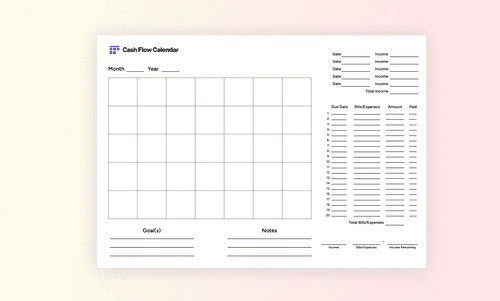
Free Printable Monthly Money Calendar (PDF Template)
Oct 8, 2025

YNAB vs. Cash Flow Calendar: Which Budgeting App Fits You Best?
Oct 8, 2025

Top 7 Budgeting Apps for Freelancers to Manage Finances Efficiently
Aug 18, 2025

YNAB (You Need a Budget) for Freelancers: Is It Worth It?
Aug 19, 2025

Wave vs FreshBooks: Which Invoicing Tool is Best for Freelancers?
Aug 19, 2025
