
- 12 min read
Maya designs websites for a living. She invoices clients on milestones with net-15 to net-30 terms, gets coffee shop pay every Friday, and sometimes picks up a delivery app payout on Sunday. Her $1,400 rent is due on the 1st, but her biggest client usually pays mid-month. She searched "what is irregular income" because monthly budget advice never shows her the exact day her balance will dip. We built a simple calendar method that turns those dates into a cash timeline she can read at a glance, and we'll walk through it with her real numbers.
What is irregular income, in one paragraph
Irregular income is money that changes in amount, in timing, or in both, so you can't count on the same deposit on the same day every month. The part people skip is this: money you've earned isn't money you can spend until it has cleared your account. An invoice marked "sent" won't pay rent. You're not alone in this. The Federal Reserve's 2025 report on household well-being puts the share of U.S. adults whose income varied at least occasionally from month to month in 2024 at 29%, and reports that 11% said that variation made it hard to pay bills. The Fed also notes that a mismatch between when income arrives and when expenses are due can cause trouble on its own.
Regular income and irregular income at a glance
The real difference between regular income and irregular income isn't the total. It's whether you can predict the date. Say a salaried friend gets $1,700 on the 1st and the 15th, so she knows rent is covered before it's due. Maya gets project pay on net-30 terms that might clear any time in a ten-day window, plus shift pay and tips that change every week.
Monthly budgets assume the first pattern. They add up everything you'll earn in June, subtract everything you'll spend, and call it fine if the answer is positive. That hides the three days in the middle, June 1 to June 3, when Maya is $740 short at the low point.
Most households have a mix. Maya has one steady stream (the Friday paycheck), one fairly steady one (delivery payouts), and two that come in lumps (client invoices). The Federal Reserve's 2024 survey appendix puts the share of adults who got roughly the same amount each month at 71%, with 29% seeing it vary at least sometimes. So it makes sense to plan for timing and amount as two separate questions.
The three problems hiding under "irregular income"
"Irregular" covers three different problems, and each one needs its own fix.
- The amount changes, the date doesn't. You work hourly shifts and get paid every Friday. The deposit lands on schedule, but it's $280 one week and $320 the next. Fix: plan on the low end.
- The amount is set, the date isn't. A client owes you exactly $1,200, but the payment clears somewhere between the 10th and the 20th. Fix: plan for the late end of the window.
- Both change. Gig bonuses and milestone payouts can be any size and come at any time. Fix: label them as uncertain and don't build bills around them.
The Federal Reserve's 2025 report on gig work found that people doing short-term gig tasks often wished their pay were more consistent, and that they tended to have lower financial well-being. Maya has all three problems at once, which is why her month feels fine on paper and tight in real life.
Meet Maya, and the real timing problem she faces
Here's Maya's actual situation, starting on Monday, May 27.
Starting balance: $540 in checking (she already did this week's grocery and gas run).
Bills and must-spend items:
- Rent, $1,400, due June 1
- Utilities, $120, due June 3
- Subscriptions, $15 due June 5 and $15 due June 15
- Car insurance, $90, due June 7
- Groceries, $120 a week, and gas, $60 a week
Income, with confidence labels:
- Coffee shop, every Friday, $280 to $320. Confirmed.
- Delivery app, Sundays, about $100. Likely.
- Client A, $1,200 invoice sent May 20 on net-15, expected June 4. Likely.
- Client B, $800 final payment, expected June 14. Uncertain.
Over six weeks Maya earns more than she spends. From May 27 to July 7, she expects $4,400 in and $4,165 out, so she finishes about $235 ahead, at $775. Her trouble is a few specific days.
Irregular income planning: build a week-by-week cash timeline
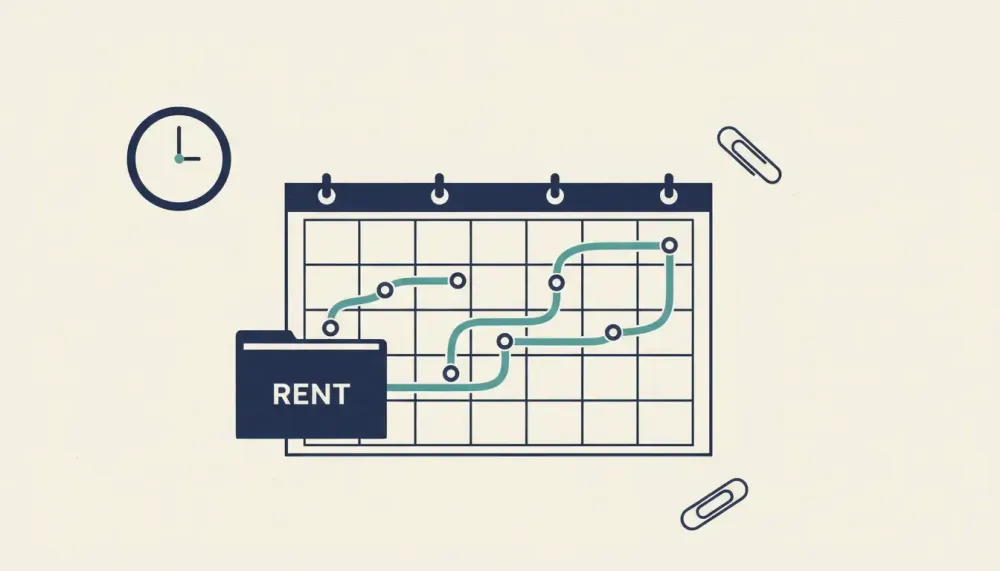
Good irregular income planning swaps the monthly budget for a dated timeline: what's in the account, what goes out on which day, and the first date the balance would drop below zero. The Federal Reserve (2025) points to mismatches between income timing and expense timing as a cause of financial difficulty. A dated projection is how you see a mismatch before it happens.
Step 1. Pick a start date and write your starting balance
Use the next business day. Write down the balance that will actually be in the account that morning, not the one your banking app shows with pending charges still waiting to post.
Step 2. Add upcoming bills and must-spend items by date
Start with fixed bills on their due dates. Then add the minimum variable spending you can't skip, like groceries and gas. Use realistic amounts, not hopeful ones.
Step 3. Add upcoming income by date and confidence label
Give every deposit one label:
- Confirmed means it's scheduled and reliable.
- Likely means it usually arrives about then.
- Uncertain means it could slip, shrink, or not show up.
Put invoices on the date you expect them to clear, not the date you sent them.
Step 4. Project the running balance to spot the dip date
Start with your balance, add each deposit, subtract each bill, in date order. You can do this day by day for the next two weeks and week by week after that. The first date the number goes negative is your dip date.
Step 5. Choose moves to cover the dip before it happens
Your options, roughly from easiest to hardest:
- Pay a bill later within its grace period, if one exists.
- Trim variable spending that week.
- Move a smaller bill earlier or later.
- Make a partial payment, if the biller allows it.
- Keep a buffer so the projected balance never goes below zero.
Worked example: Maya's next six weeks, by date and dollar amount
This is one of the clearest irregular income examples we know of, because nothing here is a disaster. The timing just doesn't line up. The Federal Reserve (2025) figure that 11% of adults struggled to pay bills because income varied makes sense once you see that a month's total can't show a three-day dip.
From June 3 on, we count $180 a week for groceries and gas, spent on Mondays. We use Maya's expected amounts here, not the low-end ones we told you to plan on, so treat these balances as a little optimistic.
Week 1 (May 27 to June 2)
- Mon May 27: start at $540
- Fri May 31: coffee shop +$320 (confirmed), balance $860
- Sat June 1: rent −$1,400, balance −$540
- Sun June 2: delivery app +$100 (likely), balance −$440 if rent went out June 1, or $960 if rent is held
That's the problem. If rent goes out on June 1, Maya is $540 short.
Week 2 (June 3 to June 9), if rent waits until June 3
- Start $960.
- Mon June 3: rent −$1,400, utilities −$120, groceries and gas −$180, balance −$740
- Tue June 4: Client A +$1,200 (likely), balance $460
- Wed June 5: subscription −$15, balance $445
- Fri June 7: coffee shop +$280 (confirmed), car insurance −$90, balance $635
- Sun June 9: delivery app +$100 (likely), ending balance $735
Here's the honest part. Paying rent on June 3 doesn't help. She still hits −$740 that day, because utilities and groceries land at the same time. There are two real fixes.
- Pay rent on June 4, after Client A clears, if her lease allows a grace period. Then June 3 ends at $660 and June 4 ends at $460, and she never goes negative. We don't know Maya's lease, and Client A is only "likely," so this fix depends on two things she doesn't control.
- Have at least $740 set aside so she covers June 1 through June 3. If Client A slips a week, she needs $755 to cover through June 10.
Weeks 3 to 6, with coffee shop at about $300, delivery at about $100, and a second $15 subscription on the 15th. These weeks include Client B's $800, which is uncertain. Our own rule says not to build bills around uncertain money, so here's the timeline with it and without it.
With Client B:
- Week 3 (June 10 to 16): start $735. Groceries and gas −$180, coffee +$300 (confirmed), Client B +$800 (uncertain), subscription −$15, delivery +$100 (likely). End $1,740.
- Week 4 (June 17 to 23): start $1,740. Groceries and gas −$180, coffee +$300 (confirmed), delivery +$100 (likely). End $1,960.
- Week 5 (June 24 to 30): start $1,960. Groceries and gas −$180, coffee +$300 (confirmed), delivery +$100 (likely). End $2,180.
- Week 6 (July 1 to 7): start $2,180. Rent −$1,400, groceries and gas −$180, utilities −$120 on July 3 (low point $480), coffee +$300 (confirmed) and subscription −$15 on July 5, car insurance −$90 and delivery +$100 (likely) on July 7. End $775.
What if Client B slips a week, from June 14 to June 21? Nothing breaks. Week 3 ends at $940 and week 4 catches up to $1,960. The real risk is Client B slipping past July 1, or not arriving at all. Then July 1 lands at −$200 after rent and groceries, and July 3 drops to −$320 after utilities. She stays negative through the end of week 6, finishing July 7 at −$25. That's the next dip date to watch, and Maya can see it a month ahead.
When a client pays late or a payout slips, update the timeline in minutes
Payments move. The Federal Reserve's 2025 findings that 29% of adults have income that varies and 11% struggled to pay bills because of it are a good reason to rerun your numbers every time an expected payment changes.
Say Client A pays on June 11 instead of June 4. Maya moves that one entry and does the math again:
- June 3: −$740
- June 5: −$755 after the subscription
- June 7: −$565 after coffee shop pay (+$280, confirmed) and car insurance
- June 9: −$465 after the delivery payout (+$100, likely)
- June 10: −$645 after groceries and gas
- June 11: $555 once Client A clears (+$1,200, likely)
That's more than a week below zero. She has three moves.
- Trim or shift variable spending by $60 to $120 this week. It helps, but on its own it won't close a gap this size.
- Split a bill within its allowed window. For example, pay part of the rent on time and the rest after the deposit, if her landlord agrees in writing.
- Move money over from a buffer and pay it back the day the deposit clears.
Watch for a few other things that can cause a slip. Platforms sometimes hold payouts. Client payments sometimes bounce. Banks can hold a deposited check for several days. If any of these is possible, push the deposit later on your timeline, not earlier.
How big should your timing buffer be, and how to build it
Here's our rule of thumb for a timing buffer: your largest single bill minus the most recent reliable paycheck before it. For Maya, that's $1,400 rent minus the $320 Friday before rent, so her target is $1,080. That would have covered her $740 low on June 3 with room left over.
Longer term, aim for 2 to 4 weeks of essential expenses. Maya's essentials come to about $2,360 over four weeks, or $590 a week, so her range is $1,180 to $2,360.
For context, the Federal Reserve (2025) found that 55% of adults had emergency savings covering three months of expenses in 2024, and 63% could cover a $400 emergency with cash or the equivalent. That leaves 45% without a three-month cushion and 37% who could not cover $400 with cash or the equivalent. A three-month cushion can take a long time to build, and that's fine. A timing buffer is a smaller and nearer goal.
How to build it:
- Move 25% of any week that ends above zero. In a quiet week Maya nets $220 ($300 + $100 − $180), so she sets aside $55.
- Save windfalls and extra shifts. If she puts $400 of Client B's payment aside, the other $680 takes about 12 to 13 quiet weeks. If that sounds slow next to her $2,180 balance on June 30, remember that the buffer is a floor her lowest projected balance should stay above, not the balance on a good day. Three days later, on July 3, that same account is down to $480.
- Keep the buffer in the same checking account. That way it actually shows up in your day-by-day projected balance instead of sitting somewhere you forget about.
Turn your dates into a calendar view with a projected balance
Doing all this on paper works. We did it on paper too. But each slipped invoice means redoing the math, and that's the part we got tired of, so we built Cash Flow Calendar.
It puts your upcoming bills and income on a calendar view and shows a projected balance for every future day, so you can see the exact date a balance would drop too low. Maya's Friday paycheck and Sunday payouts go in as recurring entries (weekly, biweekly, semi-monthly, monthly, or custom schedules). Client A's invoice and Client B's final payment go in as one-off entries. When Client A slips a week, she moves one entry and the projected balance updates.
A few other things it does:
- Optional bank connection through Plaid in the United States and Canada, to pull in real transactions and balances. Manual entry works fully without connecting a bank.
- Multiple calendars per account, so Maya could keep her design business separate from her personal bills.
- Budgets by category, transfers between accounts, and reports.
- Works on the web, iOS, and Android.
Put this to work this month
This takes about 15 minutes.
- List every bill and deposit for the next six weeks, with dates and amounts.
- Label each deposit as confirmed, likely, or uncertain.
- Run the balance forward and find your first dip date.
- Pick one move to prevent it.
- Set your first buffer target (your largest bill minus the paycheck before it).
Then do it again every week until your projected balance stays comfortably above zero. Maya's first dip is June 1. Yours might be sooner.
Your next step is to take those 15 minutes and map your next six weeks by date. If you'd rather see that plan in a calendar view, with a projected balance and all your upcoming bills and income in one place, start a free trial and build your next six weeks.

Written by
Philipp AlbrechtPhilipp Albrecht is the founder of Cash Flow Calendar. He spent years as a freelancer and built the app after missing a rent payment while waiting on client invoices — not because he didn't have the money, but because it hadn't landed yet. Everything on this blog comes from that problem: knowing what's coming in, what's going out, and on which day.
FAQs
Confirm any grace period in your lease and ask in advance if the due date can be moved or if a partial payment is acceptable with a set follow‑up date. Start a small rent fund by moving a fixed amount from each earlier payday so the 1st is covered without relying on that client. Shift smaller bills to later in the month where possible to leave room for rent at the start. Put these dates on a calendar so you can see the tight window coming.
Related Articles
How to Budget With Irregular Income and Avoid Cash Dips
Oct 25, 2026
Money Saving Budget Calendar That Boosts Savings Fast
Jun 30, 2026
How to Avoid Late Fees on Credit Cards Every Month
Jun 25, 2026
Credit Card Payment Calendar to Never Miss Due Dates
Jun 25, 2026

How to Schedule Automatic Payments Safely Without Overdrafts
Jun 22, 2026

Changing Bill Due Dates to Match Paydays Step by Step
Jun 22, 2026

Biweekly Paycheck Budget Calendar Guide and Template
Jun 21, 2026

How to use Recurring Transactions in a Calendar Budget
Oct 7, 2025

