
- 12 min read
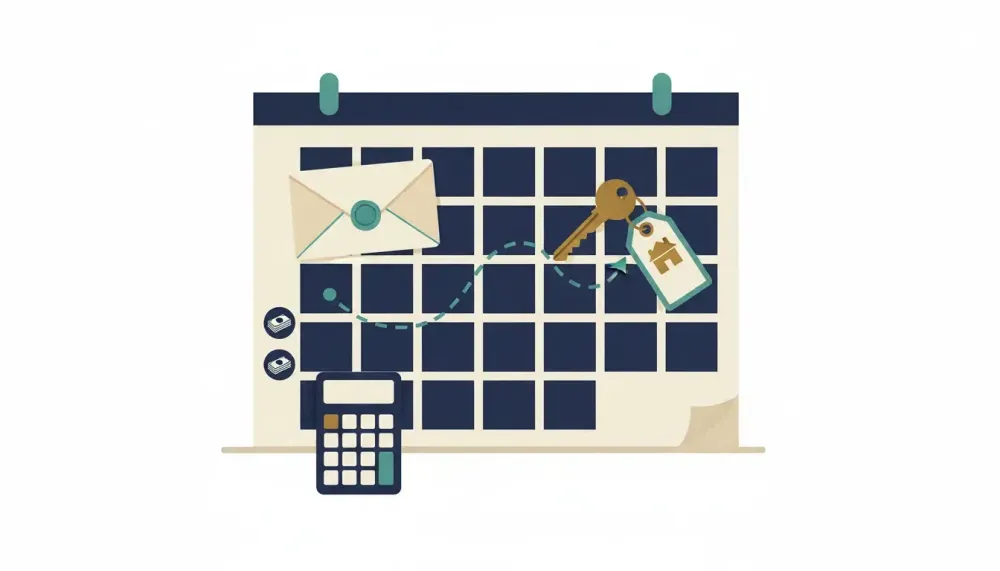
You do the work, then you wait. If you are a solo agent like Maya, your real estate agent budget keeps breaking because commissions land on closing dates, not every other Friday. Rent is due June 1. Your first commission does not clear until June 7. The math says you make enough on average. The calendar says you come up short next week.
Maya sells homes on her own and gets paid 100 percent on commission, only when a deal closes. She has two pending closings, a handful of business tools that bill her bank account automatically, and a $1,600 rent payment that shows up before either check does. She needs to know two things today: can she cover the next three weeks, and what happens if a closing slips? You need a budget for commission income that runs week by week, not a monthly average.
Why monthly averages fail when your commissions land on closing dates
Real estate agent income can be lumpy. You might close nothing for five weeks and then close two deals in ten days. A monthly budget smooths that into one tidy number, and that tidy number hides the part that actually hurts.
Rent is due June 1. Your first commission hits June 7. On paper you average $8,000 a month. In real life you can be negative on June 1 even if June 7 makes the month look fine.
We learned this the hard way: month-based budgets failed us when our income arrived in lumps. The risk is rarely the month as a whole. The risk is the six days before the money clears. The Consumer Financial Protection Bureau said in a 2025 report on bill payment that financial educators can help people create budgets, track income and bills, and ask for changes to bill due dates when that makes sense. That last part matters. Timing is something you can plan around, and sometimes change.
Gather your numbers: expected closings, due dates, and business expenses
Before any math, Maya needs three things on the table. Her current bank balance. Every bill with its exact due date. Every expected closing with its date and deal terms.
Here's the checklist we'd hand her:
- Starting point. Today's balance in each account you pay bills from.
- Personal bills. Rent, car payment, groceries, utilities, phone.
- Business costs. Software subscriptions, MLS or board dues, E&O insurance, CRM, ad spend, photography, staging, lockboxes, and any one-off invoices you already know about.
- Expected closings. Address or nickname, expected closing date, sale price, commission rate, brokerage split, referral fees, and transaction fees.
A simple real estate agent expenses spreadsheet is fine for collecting amounts. But a spreadsheet of amounts only tells you what you spend. You also need the dates, because dates are what tell you when you run out.
Collect income and expenses together, up front. The Internal Revenue Service explains in its 2025 small-business tax guide that business income and expenses must be tracked to figure net profit or loss. It also notes that self-employed people generally make estimated tax payments, because no employer is withholding taxes for them.
Turn each deal into the net commission you can actually spend
A $10,500 commission is not $10,500 you can spend. Maya has to walk each deal down from the gross number to the cash that's really hers for bills. Here are her two deals, with every assumption stated so you can swap in your own.
Deal A, expected to close June 7
- Sale price $420,000 at 2.5% = $10,500 gross commission
- Brokerage split 70/30, so Maya's share is $7,350
- Referral fee of 25% of her share = $1,837.50, leaving $5,512.50
- Transaction fee $300, leaving $5,212.50 before taxes
- Tax set-aside of 30% = $1,563.75
- Available for bills = $3,648.75
Deal B, expected to close June 28
- Sale price $600,000 at 3% = $18,000 gross commission
- Brokerage split 80/20, so Maya's share is $14,400
- Transaction fee $400, leaving $14,000 before taxes
- Tax set-aside of 30% = $4,200
- Available for bills = $9,800
Look at Deal A. A $10,500 commission turns into $3,648.75 of spendable cash. That's about 35 cents on the dollar. Splits and referrals take the biggest bites, and the tax set-aside takes the next one.
The 30% set-aside is an example, not advice. We don't know Maya's tax situation, and we don't know yours. The Internal Revenue Service says in its 2025 self-employed tax center that self-employed people generally must make quarterly estimated tax payments, and that estimated tax can include self-employment tax. A tax professional can help you pick a percentage that fits. Whatever you pick, take it off the top before you plan your spending.
Put those net commissions on a calendar and compare them with upcoming bills
Now we line it all up. Today is May 20. Maya has $1,200 in the bank. Here's what's coming out before her first payout.
- Fri May 24: ad spend $300
- Sat May 25: car payment $410
- Mon May 27: photography invoice $250
- Tue May 28: CRM subscription $89
- Fri May 31: groceries $200
- Sat June 1: rent $1,600
- Wed June 5: MLS dues $180
Her projected balance, day by day:
- May 20: $1,200
- May 24: $900
- May 25: $490
- May 27: $240
- May 28: $151
- May 31: negative $49
- June 1: negative $1,649
- June 5: negative $1,829
- June 7: Deal A adds $3,648.75, bringing her to $1,819.75
The May 24 ad spend is a one-time boost for a new listing, not a weekly charge.
This example is simplified. Real life has more grocery runs. We also combined business and personal into one balance so the math is easy to follow, and we entered Deal A at its spendable amount, assuming the tax share goes straight into a separate tax savings account.
Maya's month looks fine. Her May 31 does not. She goes below zero on groceries, a full day before rent. Then rent drops her to negative $1,649, and the MLS dues push her to negative $1,829. A negative projected balance in real life can mean overdraft fees, declined payments, or a very awkward call with a landlord. Then on June 7 the commission arrives and everything looks healthy again, which is exactly why monthly totals never caught this.
This is the practice the Consumer Financial Protection Bureau pointed to in its 2025 consumer-insights report, which identifies tracking income and bills as a budgeting habit that can help people manage bill payments. Tracking with dates is what shows the hole.
If a closing slips by two weeks, here is what changes
Closings slip. Appraisals come in late, lenders ask for one more document, a buyer's move date shifts. So let's push Deal A from June 7 to June 21 and see what Maya's calendar does.
- Earliest dip date is still May 31, at negative $49
- Largest shortfall between June 1 and June 20 is still negative $1,829, starting June 5
- Instead of recovering on June 7, she sits at negative $1,829 for about two more weeks, and deeper if any other bill lands in that stretch
- June 21: Deal A adds $3,648.75, bringing her to $1,819.75
- June 28: Deal B adds $9,800, bringing her to $11,619.75
Now the harder case. Deal A falls apart and only Deal B closes on June 28. Her worst dip stays at negative $1,829, but it lasts from June 5 all the way to June 28. Then Deal B lands and she jumps to $7,971. The total for June ends up respectable. The three weeks inside it do not.
These numbers assume no new bills after June 5, and June groceries and the June 25 car payment would push each balance lower.
Keep business and personal cash straight without mixing the books
The combined view above is good for seeing the problem. For running your life, we'd keep two separate pools of money and plan the bridge between them.
Here's how that looks for Maya:
- Business account pays ads, MLS dues, E&O, and her CRM. Commissions land here.
- Personal account pays rent, her car, and groceries.
- Transfer plan. When a commission clears, she moves money from business to personal, sized to cover personal bills until the next expected payout.
Say Deal A clears June 7 and her next expected income is Deal B on June 28. Between those dates, say she has groceries at $200 a week for three weeks ($600) and her next car payment of $410 on June 25. She transfers $1,010 to personal. The rest stays in business to cover ads and dues.
This keeps your records clean, because the Internal Revenue Service explains in its 2025 self-employed tax center that business profit or loss comes from subtracting business expenses from business income.
Forecast recurring dues and irregular marketing hits before they bite
The bills that wreck an agent's week are rarely the monthly ones. They're the quarterly and annual ones you forgot, and the listing costs that show up a couple of weeks after you've stopped thinking about them.
Put these on the calendar now, on their real dates:
- Quarterly MLS dues. Enter all four for the year, not just the next one.
- Annual association renewal. It comes once a year, which is exactly why it surprises people.
- Monthly E&O. Small, steady, and easy to miss on a card you rarely check.
- Weekly ad autopay. At $150 every Friday, that's $600 or more a month, deal or no deal.
- Photography or staging invoices. Often due about two weeks after you list, like Maya's $250.
- Lockbox purchases. These hit on listing day.
- Client gifts. These cluster near closing, right before the commission arrives.
Set up your real estate agent budget in a calendar view with a projected balance
You can do everything above with a pen and a paper calendar. We built Cash Flow Calendar because month-based budgets failed us when our income arrived in lumps. Here's how Maya would set up her numbers in it.
Add upcoming bills and income. Rent, dues, ad spend, and subscriptions go in as recurring entries on their schedules, whether that's weekly, monthly, or a custom pattern like quarterly dues. Each expected closing goes in as a one-off income entry on its real closing date, at the net amount you can spend. For Maya, that's $3,648.75 on June 7 and $9,800 on June 28.
Look at the calendar view. Upcoming bills and income appear on a calendar, with a projected balance for every future day. Maya would see her balance tip below zero on May 31 without doing any subtraction herself.
Move a date when a closing moves. If Deal A slips to June 21, she changes the date and the projected balance updates. That's the two-week slip scenario.
Connect a bank, or don't. In the US and Canada you can connect your bank through Plaid to pull in real transactions and balances. Manual entry works fully without it.
Keep business and personal apart. One account can hold multiple calendars, so Maya can run a business calendar and a personal one, and record transfers between her business and personal accounts. Budgets by category and reports help when she reviews where the money went.
It runs on the web and on iOS and Android. There's a free trial, then a paid subscription.
How much cash you need before the next payout
This is the question Maya actually Googled. Here's the method we'd use. It's a method, not a guarantee.
Today is May 20. Add up every obligation from today through the day after your earlier expected closing. Deal A is June 7, so count through June 8.
- Outflows: $300 + $410 + $250 + $89 + $200 + $1,600 + $180 = $3,029
- Starting balance: $1,200
- Shortfall: $3,029 minus $1,200 = $1,829
That $1,829 is the minimum buffer Maya needs to avoid a dip, and only if Deal A lands on time.
Then add a margin for funds that take one to two business days to clear, by counting any bills due in the two business days after June 7. For Maya, that's Monday June 10 and Tuesday June 11, and nothing is due on either day, so her on-time buffer stays $1,829. A Friday closing can easily mean Monday money.
Now be honest about the pipeline. If a deal feels less than about 80 percent likely to close on schedule, size your buffer as if it won't. Say Maya rates Deal A at 70 percent. She should plan as if it closes June 21, and add every bill due between June 8 and June 22 to her total. In that window she has two grocery runs, $200 on June 14 and $200 on June 21, which brings her buffer to $2,229.
We wish we could give you one magic buffer number. There isn't one. The Consumer Financial Protection Bureau identifies budgeting and tracking income and bills as tools that help people manage payment timing in its 2025 report, but it doesn't set a universal cash buffer for self-employed workers. Your buffer comes from your own dates.
A 15 minute weekly routine to stay ahead of delays and surprises
A forecast is only as good as its last update. Pick one time each week, say Monday morning before showings, and do two things.
Update statuses: expected, closed, and cleared funds
Mark which deals are still expected, which have closed, and which have actually cleared into your account. These are three different states. A deal that closed Friday may not be money you can spend until Tuesday. Only cleared funds pay rent.
Move dates, scan the projected balance, decide actions
Shift any closing that's slipping. Then scan the projected balance for the next few weeks. If a dip appears, decide today what to do: which spend to pause, which bill to ask about rescheduling, or whether to plan a short bridge with a clear payback date.
Here's Maya on Monday, May 27. Her lender says Deal A is likely to slip a week. She moves it to June 14, sees the dip stretch longer, and holds off on booking any new ad spend for two weeks. She also calls her landlord about moving rent to June 17, the Monday after a Friday June 14 closing. That's the kind of due-date request the Consumer Financial Protection Bureau mentions in its 2025 report, alongside creating budgets and tracking income and bills. It took her 15 minutes, and none of it was an emergency yet.
Your next step today
You can do this in one sitting:
- Enter your starting balance.
- Add the next 30 days of bills with exact due dates.
- Add every pending closing (Maya has two, you may have three) at its net amount, on its real date.
- Look at the projected balance. If a dip appears, make one decision now to cover it. Move a due date, pause a spend, or plan a small bridge you can repay after the payout.
No one is withholding taxes for you. The Internal Revenue Service notes in its 2025 self-employed tax center that self-employed people generally pay estimated tax because no employer withholds income, Social Security, and Medicare taxes. That means a current forecast of your commissions, expenses, and tax reserves is your earliest warning.
Find the date your own balance dips while there's still time to act on it.

Written by
Philipp AlbrechtPhilipp Albrecht is the founder of Cash Flow Calendar. He spent years as a freelancer and built the app after missing a rent payment while waiting on client invoices — not because he didn't have the money, but because it hadn't landed yet. Everything on this blog comes from that problem: knowing what's coming in, what's going out, and on which day.
FAQs
Start by turning each pending deal into the cash you can actually spend after splits, fees, and a tax reserve. Put those net amounts and every bill on their exact dates and track a running daily balance. If you see a shortfall in an upcoming week, decide now whether to delay a discretionary expense, request a new due date, or line up a small bridge with a clear repayment date. A calendar view helps you spot the gap without doing math each time.
Related Articles
What Is Irregular Income and How to Plan by Date This Month
Oct 26, 2026
How to Budget With Irregular Income and Avoid Cash Dips
Oct 25, 2026

Money Saving Budget Calendar That Boosts Savings Fast
Jun 30, 2026

How to Avoid Late Fees on Credit Cards Every Month
Jun 25, 2026
Credit Card Payment Calendar to Never Miss Due Dates
Jun 25, 2026

How to Schedule Automatic Payments Safely Without Overdrafts
Jun 22, 2026
Changing Bill Due Dates to Match Paydays Step by Step
Jun 22, 2026

Biweekly Paycheck Budget Calendar Guide and Template
Jun 21, 2026
How to use Recurring Transactions in a Calendar Budget
Oct 7, 2025

