
- 12 min read
Jordan, you're a freelance designer in the US. Two clients pay you by ACH, a platform pays out around the 6th, and the big checks tend to land in the last week of the month. A $6,000 1099 payment just cleared two days before your $1,450 rent, and you want to know how much of it belongs to freelance taxes before you spend any of it.
We've been there. We started building our own tools after month-based budgets kept failing us when income showed up in lumps. Below, we turn the IRS's quarterly bills into a weekly set-aside, with dates, percentages, and one rule you can run every time money lands.
The 5-minute brief on how freelance work taxes actually work
Freelance income is self-employment income. Nobody withholds tax from it, so tax only leaves your account when you send it.
The Internal Revenue Service's 2026 self-employed tax center says people with net earnings from self-employment of $400 or more generally must file a federal return. Business income generally goes on Schedule C, and self-employment tax is figured on Schedule SE. That's the paperwork side of filing taxes as a freelancer. The cash side is harder.
The IRS wants money during the year, not just in April. The IRS's 2026 Form 1040-ES lists these general due dates for estimated payments:
- April 15, 2026
- June 15, 2026
- September 15, 2026
- January 15, 2027
Your state, and sometimes your city, may want estimated payments too, so check their rules separately. And keep records from day one: invoices, payouts, receipts for software and gear.
Start with what you really owe: estimate your annual freelance taxes from profit
Self employed, how much should I save for taxes? The honest answer starts with a different question. How much profit will you make?
Profit is what you earn minus your ordinary and necessary business expenses, like software subscriptions, a new monitor, or a coworking desk. Tax comes from profit, not from the gross number on your invoices.
You owe two federal taxes on that profit. Self-employment tax covers Social Security and Medicare, and the IRS's 2026 Form 1040-ES tells you to figure it on 92.35% of net profit. Income tax comes on top, after deductions. The IRS's 2026 estimated-tax page says estimated tax generally covers both. It also says you generally avoid an underpayment penalty if you'll owe less than $1,000 after withholding and credits, or if you pay at least 90% of this year's tax or 100% of last year's, whichever is smaller.
The worksheet flow:
- Profit: expected income minus expected expenses.
- Self-employment tax: profit × 0.9235 × 15.3% (worked out in the example below).
- Federal income tax: estimate a rate from last year's return or a bracket lookup.
- State income tax, if your state has one.
- Add steps 2 to 4 for your annual estimate.
This is an estimate. We don't know your deductions, your state, or next quarter, and neither do you yet. The number just needs to be close enough to become a saving rate.
From annual to per-payment: pick a saving rate you can actually use
As a 1099 contractor, how much do I save from each payment? Start by turning the annual number into a rate.
Divide your annual tax estimate by your annual profit. That's your base rate. The IRS's 2026 Form 1040-ES worksheet turns projected income, deductions, self-employment tax and withholding into an annual estimated-tax amount. We turn that number into a percentage of profit, because your money doesn't arrive in tidy quarters.
Then add a cushion. Our rule has two parts:
- Base: skim your base rate from the profit in every payment.
- Top-up: skim an extra 2% into a separate cushion until it equals one quarter's projected payment. Then pause the top-up.
Say you expect $21,000 of tax on $70,000 of profit. Your base rate is 30% (21,000 ÷ 70,000). One quarter's payment is $5,250 (21,000 ÷ 4), so that's the cushion target. Until it's full, you skim 32%.
Fair warning: 2% of $70,000 is $1,400 a year, so at that pace the $5,250 cushion takes nearly four years to fill ($5,250 ÷ $1,400 ≈ 3.75). If you want it full this year, you'll need to add extra in strong months.
The safe harbor helps you size things. The IRS's 2026 estimated-tax FAQ describes it as the smaller of 90% of this year's tax or 100% of last year's, with 110% of last year's for certain higher-income taxpayers. Your quarterly payments need to reach that smaller number. The cushion is there so one slow quarter doesn't knock you below it.
Worked example 1: solo 1099 freelancer with irregular months
Jordan, here's your year as a 1099 freelance designer, in example numbers:
- Gross receipts: $90,000
- Business expenses: $20,000
- Profit: $70,000
The IRS's 2026 Form 1040-ES applies the 15.3% self-employment tax rate to net earnings figured at 92.35% of profit. So 70,000 × 0.9235 × 0.153 comes to about $9,891, before any Social Security wage-base limit.
Now say your federal income tax works out to about $7,600 and your state tax to about $3,500. Those are stand-ins, so use figures from your own return. Your total is $9,891 + $7,600 + $3,500 = $20,991. Call it $21,000. That's the 30% base rate from above, or 32% while the cushion fills.
Now the collision. On June 29, a client's $6,000 ACH payment lands. Rent of $1,450 is due July 1. Your June business costs (about $1,667, which is $20,000 ÷ 12) already came out of the June 6 platform payout, so this whole check counts as profit.
Same day:
- Move 32% to your tax reserve: $1,920 ($1,800 base plus $120 cushion).
- Keep $4,080 in checking.
- On July 1, rent takes $1,450 of that, leaving $2,630 for the rest of the month.
The $1,920 is not an IRS payment. It's a transfer to an account you control. The IRS's 2026 estimated-tax FAQ sets quarterly due dates, so June 29 money waits. June 15 has passed, which means your $1,800 joins the pile for September 15. Rent gets paid from what's left after the skim, never from the reserve.
Worked example 2: mixed-income household (W-2 plus 1099)
A paycheck changes the math. This illustrates the method. It isn't tax advice.
- Partner A has a W-2 job with $12,000 of federal tax withheld this year.
- Partner B freelances, with $40,000 of profit.
Self-employment tax on Partner B's profit is 40,000 × 0.9235 × 0.153, about $5,652. Say the household's federal income tax on both incomes comes to $14,000. Total federal tax is $19,652.
As we read the IRS's 2026 estimated-tax FAQ, estimated-tax requirements are figured after withholding and refundable credits come off. So $19,652 minus the $12,000 already withheld leaves $7,652 for Partner B's set-asides to cover.
That's a rate of about 19% on freelance profit (7,652 ÷ 40,000), or about $147 a week (7,652 ÷ 52). Using Jordan's 30% would have stashed $12,000, about $4,350 more than needed, sitting idle while rent comes due.
Our takeaway, not the IRS's wording: a mixed-income household should compare its projected total with both safe-harbor targets in IRS Publication 505 for 2026 before putting a full freelance rate on every 1099 dollar. State tax works the same way, on top.
Weekly routine: what to do every time money hits your account
- Log the payment and note which client paid. Good records make filing taxes as a freelancer far less painful, and they show you who pays late](https://www.cashflowcalendar.app/blog/the-freelancer-guide-to-invoicing).
- Same day, move your rate times the profit to a separate tax reserve account. At 30% plus a 2% top-up, a $6,000 receipt moves $1,920.
- Mark what's left as available for bills, starting with rent on the 1st.
- Once a week, reconcile. Update your profit and reserve totals, and check how close the cushion is to full.
- On the quarterly due dates in the IRS's 2026 Form 1040-ES, send the quarter's reserve to the IRS. Not before.
Step 5 matters more than it looks. The IRS's 2026 pay-as-you-go guide separates estimated tax, paid during the year on set dates, from withholding, which comes out of wages. A transfer to your own savings pays nobody. It's just you being organized.
Those dates are your checkpoints. We'd hold the money until then, because cash sent early is out of reach when a client pays late and rent doesn't wait.
Smooth the bumps: rules for strong and slow months
Percentages work until a month goes quiet. Here are example guardrails. Tune them to your numbers:
- Floor: set aside at least $150 a week, even in slow months.
- Cap: in a very lean week, never skim more than 35% of that week's profit.
- Catch-up: fill any shortfall from the next strong month before the due date.
If they clash, say in a week with only $300 of profit, the cap wins. You skim $105, rent stays safe, and the gap goes on the catch-up list.
A catch-up in action: by September 9, your September 15 pile holds $3,900 of its $5,250 target, $1,350 short after a slow August. The cushion is nowhere near full this early, so you're still skimming 32%. On September 10, a $5,000 check lands, all profit. The 32% skim is $1,600: $1,500 to the September pile and $100 to the cushion. That brings the pile to $5,400. You send $5,250 on September 15, and $150 rolls toward January. You leave the cushion alone because the September 10 check covers the gap, and the cushion is for a quarter when no catch-up check arrives before the due date.
The safe harbor on the IRS's 2026 estimated-tax page gives you a real number to catch up to. And IRS Publication 505 for 2026 allows the annualized-income installment method when income is uneven, instead of assuming it arrives evenly across four quarters. It's more paperwork, but if your income really does come in lumps, it may help.
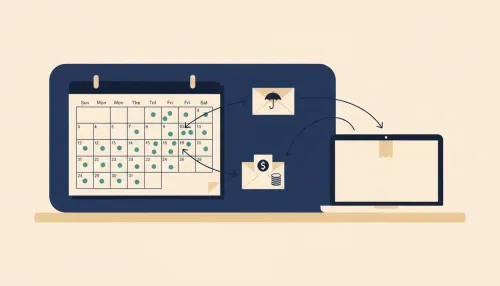
Put taxes on the calendar so the money is visible before it leaves
Most tax trouble isn't a math problem. It's a visibility problem. The money sits in checking, looks like yours, and quietly becomes groceries.
The IRS's 2026 pay-as-you-go guide explains estimated tax as paying as you earn, not postponing it all until you file. So treat freelance work taxes like rent: dated money that leaves on a known day.
Jordan, picture your early summer, before the August client:
- June 29: $6,000 client payment in, $1,920 set-aside out.
- July 1: $1,450 rent out.
- Every Friday: a transfer to the reserve for that week's smaller receipts.
- July 6: platform payout in.
- September 15: $5,250 federal estimated payment out of the reserve.
Laid out like this, you can see the $6,000 come in and the $1,920 go out on June 29, so checking rises by a net $4,080 that day. Then it drops by $1,450 on July 1 and recovers on July 6. Enter each due date from the IRS's 2026 Form 1040-ES as a dated outflow next to rent and expected client receipts. No more meeting September 15 for the first time on September 14.
Walkthrough: set weekly tax set-asides in Cash Flow Calendar
Here's what to enter in Cash Flow Calendar. We're describing the setup, not specific buttons.
- Add a recurring weekly transfer called "Tax set-aside" on Fridays, from checking to your tax reserve account, in a budget category you name "Taxes." Each week, update the amount to your skim from that week's receipts. Because it's a transfer, both balances stay accurate.
- When a big check lands on a Monday, like June 29, enter that day's set-aside as a one-off transfer on the date it actually moves.
- Add four one-off expenses for the federal estimated payments, one on each quarterly due date.
- Add expected client income on its usual dates, like the platform payout on the 6th.
- Optional: connect your bank through Plaid (US and Canada) to compare your plan with real transactions. Manual entry works fully without it.
Then open the calendar view. Jordan, you'll see the June 29 set-aside and the July 1 rent side by side, with a projected balance for every day between. If the balance would dip too low before rent, you'll see that date ahead of time. It won't make a client pay faster. It just shows you the problem while there's still time to plan around it.
What to change mid-year if your numbers shift
Your rate isn't fixed. IRS Publication 505 for 2026 lets you recalculate estimated tax during the year and revise later installments when income, deductions, credits or withholding change.
Say a new client in August adds $20,000 of profit, taking Jordan's year to $90,000. Redo the estimate:
- Self-employment tax: 90,000 × 0.9235 × 0.153, about $12,717.
- Federal income tax, example: about $11,800.
- State income tax, example: about $4,500.
- New total: $29,017. Call it $29,000.
The new base rate is about 32% (29,000 ÷ 90,000), up from 30%, on every payment from here on.
The IRS's 2026 estimated-tax FAQ puts the safe harbor at generally 90% of this year's tax or 100% of last year's, with 110% of last year's in specified higher-income cases. Say last year's return showed $24,000 of total tax. Ninety percent of $29,000 is $26,100, so the smaller target is $24,000.
You've paid $10,500 so far ($5,250 each in April and June). That leaves $13,500, or $6,750 on each of the two remaining dates. So top up the September 15 pile by $1,500 from the new client's first checks, and change the September 15 entry on your calendar from $5,250 to $6,750.
Topping up later doesn't automatically cover earlier installments, so April and June can still count as short. If your income really did jump in August, the annualized-income installment method in IRS Publication 505 for 2026 may let your installments reflect when that income actually arrived.
Two honest notes. The safe harbor is about avoiding a penalty, not what you owe, so you'd still owe about $5,000 more at filing. And we can't tell you whether the 110% rule applies to you. Your prior-year return or a tax pro can.
Quick references you'll actually use
- Payment dates: the IRS's 2026 estimated-tax FAQ gives April 15, June 15, September 15 and January 15, 2027.
- When estimates apply: the same 2026 IRS FAQ points to expecting at least $1,000 due after withholding and credits, and falling below the 90% or prior-year safe harbor.
- Filing trigger: $400 or more of net self-employment earnings generally means filing, per the IRS's 2026 self-employed tax center.
- Forms: Schedule C for business income, Schedule SE for self-employment tax, per the same 2026 IRS page.
Jordan, before your next client pays, put your weekly tax set-aside and the four quarterly payments on a calendar, so your projected balance is always in view and September's money is visible in June, before it quietly becomes something else. Start a Cash Flow Calendar free trial to see your upcoming bills and income next to the exact days your tax transfers and payments leave, and check the plans on the pricing page.

Written by
Philipp AlbrechtPhilipp Albrecht is the founder of Cash Flow Calendar. He spent years as a freelancer and built the app after missing a rent payment while waiting on client invoices — not because he didn't have the money, but because it hadn't landed yet. Everything on this blog comes from that problem: knowing what's coming in, what's going out, and on which day.
FAQs
Yes. You can submit a new W-4 to have more tax withheld from paychecks, and withholding is treated as if paid evenly through the year, which can reduce or replace estimates. Calculate how much extra to withhold based on your latest projection, and check your safe-harbor target. Revisit mid-year if income or deductions change.
Related Articles
Self Employed Budget on One Calendar, Projected Balance
Oct 26, 2026
Quarterly Estimated Tax Calendar For Freelancers Due Dates
Jun 25, 2026
Freelance Cash Flow Forecast Template Excel Spreadsheet
Jun 17, 2026
Visual Budget Planner for Gig Workers to Track Cash Flow
Jun 17, 2026
How to Pay Yourself a Salary as a Freelancer Step by Step
Jun 16, 2026
Best Gig Economy Platforms to Earn Extra Money by Net Pay
Apr 12, 2026
How to Price Freelance Services: Set Rates and Cash Flow
Apr 12, 2026
Best Tax Advisor for Freelancers and How to Choose
Apr 11, 2026
How to Estimate Quarterly Taxes for Freelancers With 4 Dates
Apr 11, 2026
Tax Deductions for Freelancers You Can Claim This Year
Apr 10, 2026
How to Build a Safety Net as a Freelancer
Aug 19, 2025
Top 7 Budgeting Apps for Freelancers to Manage Finances Efficiently
Aug 18, 2025
The best ways to track expenses as a freelancer
Aug 19, 2025
How to Create an Invoice as a Freelancer
Aug 19, 2025
YNAB (You Need a Budget) for Freelancers: Is It Worth It?
Aug 19, 2025
Wave vs FreshBooks: Which Invoicing Tool is Best for Freelancers?
Aug 19, 2025
The Freelancer’s Guide to Invoicing
Aug 19, 2025
How to Track and Deduct Business Expenses as a Freelancer
Aug 18, 2025
How to Save for Vacation as a Freelancer
Aug 18, 2025
How to Separate Business and Personal Finances as a Freelancer
Aug 18, 2025
How to forecast Income as a Freelancer
Aug 18, 2025
Freelancers vs Traditional Jobs: Why Budgeting is Different
Aug 18, 2025
How to Plan for Seasonal Work as a Freelancer
Aug 18, 2025
How to budget for a large purchases as a Freelancer
Aug 18, 2025

