
- 13 min read
Maya is a freelance graphic designer, and her self employed budget never seems to match the calendar. Rent is due on the 1st and health insurance on the 5th, but her biggest client often pays on the 20th instead of the 15th. When payments do arrive, they land by ACH on Tuesdays and Fridays, which leaves a dip right when the bills come due.
She invoices on delivery with Net 15 to Net 30 terms, so she rarely knows the exact day money will show up. What she does know is the feeling of checking her balance before paying rent and doing math in her head about the tax money she hasn't set aside yet.
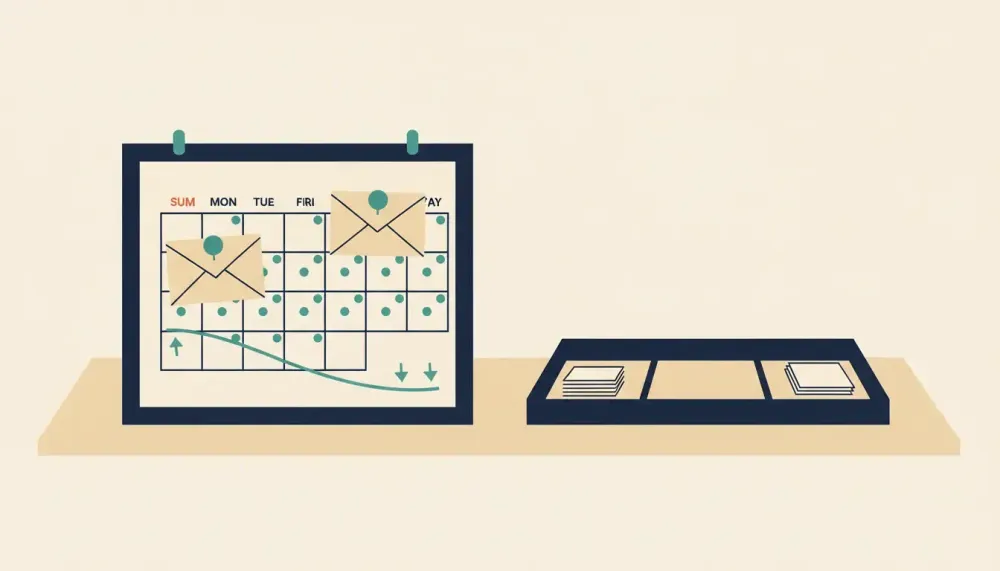
We built our planner because we lived this. Below is the date-based plan we use. Bills and expected deposits go on one calendar with a running projected balance, so Maya can see what she can spend and when.
Why monthly budgets fail when your income does not land on the first
A monthly budget asks one question: does income cover expenses this month? For a salaried person paid on a set schedule, that's a fine question. For Maya, it's the wrong one. The month can come out ahead and she can still overdraft on the 2nd.
Say Maya's account looks like this in April, back when everything ran through one account.
- Apr 1, Personal. Starting balance $300. Rent of $1,400 due. Projected balance -$1,100.
- Apr 10, Personal. Deposit of $2,000 arrives. Projected balance $900.
- Apr 25, Personal. Deposit of $800 arrives. Projected balance $1,700.
On a monthly budget, April looks healthy, with $2,800 in and $1,400 out. But from the 1st to the 9th, the account is $1,100 short. That gap is the real problem, and a monthly total hides it completely.
A calendar with a running projected balance for each day shows the exact date the dip happens. Once you can see it, you can do something about it ahead of time. You can move a bill, shift a transfer, or hold off on a purchase before the bank charges you for the surprise.
Build a self employed budget that runs on dates, not averages
A date-based plan has three parts. You keep one timeline of upcoming bills and income. You track a running projected balance that changes with every event. And you do a weekly check-in to plan the next stretch.
For freelance income, it helps to separate three dates that often get blurred together.
- Invoice date. The day you send the invoice.
- Expected payment date. The invoice date plus the client's terms, shifted to the client's usual pay day.
- Actual deposit date. The day the money really lands.
For cash planning, put the expected payment date on the calendar first. When the ACH arrives, update the event to the actual deposit date.
Say Maya delivers a logo project and invoices $1,800 on Tuesday, March 19, with Net 15 terms. Fifteen days later is Wednesday, April 3. Her client pays by ACH on Tuesdays and Fridays, so the first realistic landing day is Friday, April 5. She puts the expected deposit on April 5.
Then the client runs a little late, and the money lands the following Tuesday, April 9 instead. Maya moves the event to April 9, and her projected balance for April 5 to 8 drops by $1,800. If that drop pushes any day too low, she sees it now, not when a bill bounces.
Keep business and personal connected without mixing money
The cleanest setup we've found uses two accounts with planned transfers between them. Maya's look like this.
- Business Checking. Client payments land here. Tax money gets set aside from here. Business costs like software and insurance get paid from here.
- Personal Checking. Rent, groceries, health insurance, and the rest of her household spending come out of here.
The bridge between them is a weekly owner draw. For example, every Friday Maya moves $600 from Business to Personal. She plans that transfer on the calendar like any other bill, with a date and an amount.
This is the part that makes lumpy income feel less lumpy. Business takes the hit when a client pays late or a month is slow. Personal gets the same $600 every Friday, so her household spending stays steady. One pot that does everything is how you end up spending next quarter's tax money on groceries without noticing.
Choose a conservative income floor and a steady weekly draw
The draw only works if it's sized for your slow months, not your good ones. A great March is the most dangerous month to set your budget in.
Here's the method we use.
- Look at the last 6 to 12 months of actual deposits into Business. Use money received, not money invoiced.
- Pick your 3 lowest months.
- Average them. That's your monthly income floor.
Say Maya's three worst months brought in $3,800, $4,200, and $4,500. That adds up to $12,500, and dividing by 3 gives an income floor of about $4,167 a month.
At $600 a week, her draw comes to $2,400 in a month with four Fridays and $3,000 in a month with five. Across a full year that averages about $2,600 a month ($600 times 52 weeks, divided by 12). A 25 percent tax reserve on her $4,167 floor is about $1,042. Sinking funds take about $299 a month ($69 times 52 weeks, divided by 12). That leaves about $226 a month for software and a buffer. It's room, but it's thin, and we'd rather say so plainly.
We don't know your numbers, and a floor built on past months can't promise next month. It's simply a safer starting point than your average.
Turn annual and quarterly costs into weekly sinking funds
Big bills that come once a year or once a quarter can wreck an otherwise fine week. The fix is boring and it works. You fund them a little at a time, on a set day.
Maya puts these on the calendar as weekly transfers every Friday, from Business to a separate business savings account.
- Annual software bundle. $360 a year, about $7 a week.
- Laptop replacement. $1,200 every 2 years, about $12 a week.
- Professional liability insurance. $600 a quarter, rounded up to $50 a week. The exact figure is about $46, so the extra few dollars give her a small cushion.
That's $69 a week. When the insurance bill arrives, the money is already sitting there. Nobody has to panic in a coffee shop.
Quarterly estimated taxes work the same way, but they're bigger and have fixed federal due dates, so they get their own section next.
Reserve taxes from every client payment without starving your budget
The simplest tax habit we know is to set aside a share of every deposit on the day it lands. That way you aren't hunting for a lump sum in April.
For this example, we'll use 25 percent. That's a rule of thumb for illustration, not your rate. Your actual rate depends on your income, deductions, and state, so check the IRS worksheets or ask a tax pro.
Say a $2,000 client payment hits Business on a Tuesday. On that same day, the calendar shows three events.
- Tax reserve. $500 (25 percent) moves to a separate tax savings account.
- Sinking funds and business costs. $200 stays earmarked for weekly sinking funds and things like software.
- Draw and buffer. The remaining $1,300 supports Friday's owner draw and a cushion in Business.
That adds back up to $2,000. To keep the math simple, we apply the 25 percent to each deposit. If you have large business expenses, your tax-pro rate may be based on a smaller net figure.
Timing matters here too. According to the 2026 estimated tax instructions from the Internal Revenue Service, estimated payments for self-employed people are generally due four times a year. The dates are April 15, June 15, September 15, and January 15 of the following year. Put all four on your calendar as bills paid from your tax reserve. They're as fixed as rent, and they don't care when your client pays.
A five-week worked example with a running projected balance
Here's the full system across a sample April where the 1st falls on a Monday. Both scenarios share the same setup.
- Business starting balance. $2,000 on Mon Apr 1.
- Personal starting balance. $300 on Mon Apr 1.
- Personal bills. Rent $1,400 due Mon Apr 1. Health insurance $420 due Fri Apr 5. Utilities $160 due Wed Apr 17. Phone $80 due Mon Apr 22.
- Business bill. Software $30 due Tue Apr 16.
- Owner draw. $600 every Friday from Business to Personal.
- Sinking funds. $69 every Friday from Business.
- Tax reserve. 25 percent of each Business deposit, set aside the day it lands.
- Expected deposits to Business. $1,800 on Tue Apr 9, $2,400 on Fri Apr 19, $1,200 on Tue Apr 30.
One honest note first. In a real April, the April 15 estimated tax payment would also sit on this calendar, paid from the tax reserve. We left it out so the lines stay readable. You shouldn't leave it out.
Scenario A: client pays on time
- Apr 1, Personal. Rent -$1,400. Projected balance -$1,100.
- Apr 1, Business. Starting balance $2,000.
- Apr 5, Business. Sinking funds -$69. Projected balance $1,931.
- Apr 5, Business. Owner draw -$600 to Personal. Business $1,331. Personal -$500.
- Apr 5, Personal. Health insurance -$420. Projected balance -$920.
- Apr 9, Business. Deposit +$1,800, tax reserve -$450. Projected balance $2,681.
- Apr 12, Business. Sinking funds -$69. Projected balance $2,612.
- Apr 12, Business. Owner draw -$600. Business $2,012. Personal -$320.
- Apr 16, Business. Software -$30. Projected balance $1,982.
- Apr 17, Personal. Utilities -$160. Projected balance -$480.
- Apr 19, Business. Deposit +$2,400, tax reserve -$600. Projected balance $3,782.
- Apr 19, Business. Sinking funds -$69. Projected balance $3,713.
- Apr 19, Business. Owner draw -$600. Business $3,113. Personal $120.
- Apr 22, Personal. Phone -$80. Projected balance $40.
- Apr 26, Business. Sinking funds -$69. Projected balance $3,044.
- Apr 26, Business. Owner draw -$600. Business $2,444. Personal $640.
- Apr 30, Business. Deposit +$1,200, tax reserve -$300. Business $3,344.
Reading the line. Business stays healthy the whole month. Personal is negative from Apr 1 until the Apr 19 draw, and a projected -$1,100 isn't a plan. It's an alarm. If nothing changes, that's an overdraft on day one.
The calendar shows it before April even starts, and the fix is clear. A one-time $1,200 transfer from Business on Apr 1 keeps Personal positive all month, with a low of $100 on Apr 1. Business dips to $131 after the Apr 5 draw. That's thin but still positive, and the Apr 9 deposit refills it.
Scenario B: the Apr 19 payment arrives Apr 24 instead
This is Maya's usual problem, a client who slips by a few days. At her Monday, Apr 15 check-in, the client tells her the Apr 19 payment will be late. That same day, she makes these changes in order.
- Cut the Apr 19 draw to $300.
- Pause sinking funds on Apr 19, then restore them on Apr 26.
- Ask to move utilities 3 days later, to Sat Apr 20, if the company allows it.
Apr 1 through Apr 16 run exactly as in Scenario A, ending with Business at $1,982 and Personal at -$320.
- Apr 17, Personal. Utilities moved to Apr 20. Personal stays at -$320.
- Apr 19, Business. No deposit. Sinking funds paused. Reduced draw -$300. Business $1,682. Personal -$20.
- Apr 20, Personal. Utilities -$160. Projected balance -$180.
- Apr 22, Personal. Phone -$80. Projected balance -$260.
- Apr 24, Business. Deposit +$2,400, tax reserve -$600. Projected balance $3,482.
- Apr 26, Business. Sinking funds resume -$69. Projected balance $3,413.
- Apr 26, Business. Owner draw -$600. Business $2,813. Personal $340.
- Apr 30, Business. Deposit +$1,200, tax reserve -$300. Business $3,713.
Reading the line. On Apr 15, Maya knows the payment is late, but not by how much. In the lines above, the cut doesn't help much. Business never drops below $1,682, and the smaller draw only makes Personal worse. Personal stays negative longer, until the Apr 26 draw.
The cut earns its place in the version with the $1,200 Apr 1 transfer. There, Business on Apr 19 is $482 with the cut and $113 without it. If the payment slipped another week, the Apr 26 draw would push Business negative.
With the same $1,200 transfer on Apr 1, Personal never goes below $100 in this scenario either, and Business bottoms out at that same $131 on Apr 5. Without that transfer, the calendar is telling Maya to make a choice. She can move another bill, add a small top-up draw once the money lands on Apr 24, or trim spending for the week. Whichever she picks, she picks it on a Monday instead of finding out from a fee notice.
When cash gets tight, use this weekly triage to avoid overdrafts
When a payment slips, you don't need a new budget. You need an order of operations. Here's ours, for one lean week.
- Protect essentials with fixed due dates, like rent, health insurance, and utilities.
- Reserve minimum debt payments.
- Keep basic groceries and transport.
- Reduce or skip discretionary spending.
- Trim the owner draw for one week if needed.
- Pause sinking fund transfers for one cycle, then catch up.
- Ask vendors for due date flexibility before you incur fees.
Look at how Maya used it in Scenario B. With the $1,200 transfer on Apr 1, rent and health insurance came out of a positive balance instead of pushing Personal below zero. The draw got cut and the sinking funds paused for one Friday, both of which she could catch up on. Asking the utility company came last because it depends on someone else saying yes.
We can't tell you which vendors will move a date. Some will, some charge for it, and some won't budge. That's why asking sits at the bottom of the list. It's worth trying, but it's not something to count on.
Use a self employed budget planner with a calendar view and projected balance
You can run this whole method with a spreadsheet and patience. We built Cash Flow Calendar so you don't have to. As we describe on the Cash Flow Calendar blog (2026), the planner shows upcoming bills and income on a calendar, projects a balance for each future day, and works on the web, iOS, and Android.
Here's how Maya would set up her self employment budget in it.
- Recurring items. Add rent, health insurance, utilities, phone, and software on the real dates they're due. Add one-off entries for irregular events, like a single project payment or a yearly renewal.
- Client payments. Enter each expected payment on the date her terms and the client's ACH days point to. When the deposit lands, update the event to the actual date.
- Weekly transfers. Add the Friday owner draw from Business to Personal, plus the weekly sinking fund transfers.
- Labels. Start each event's name with "Business" or "Personal." The label only tells Maya which account an event belongs to. The calendar still projects one running balance.
- The projected balance line. Scan it for the first day a balance would dip too low. Then adjust the draw or move a flexible bill before that day arrives.
Your next step is to start a free trial and see your projected balance before the week starts.
Make it a 20 minute weekly habit
The setup takes an evening, and keeping it accurate takes about 20 minutes every Monday morning, before anything is due.
- Reconcile last week's actual deposits, and move any late payments to the date they really landed.
- Scan the next 14 days of upcoming bills and income in the calendar view.
- Confirm Friday's owner draw and the weekly sinking fund amounts.
- Check the projected balance line for dips, and use the labels to see which account each event hits.
- If a dip appears, apply the triage order now rather than mid-week.
For Maya, that Monday check is where the slipping client stops being a surprise. On Monday, Apr 15, she sees the Apr 19 deposit is at risk and trims Friday's draw before the bills land.
Set up next Friday's owner draw and your weekly sinking funds on the calendar now. Then scan the next 14 days for the first dip in your projected balance and make one small change to fix it.

Written by
Philipp AlbrechtPhilipp Albrecht is the founder of Cash Flow Calendar. He spent years as a freelancer and built the app after missing a rent payment while waiting on client invoices — not because he didn't have the money, but because it hadn't landed yet. Everything on this blog comes from that problem: knowing what's coming in, what's going out, and on which day.
FAQs
Start with a small weekly figure and back-test the next 8 to 12 weeks on your calendar to see the lowest projected day. If any day dips too close to zero, trim the weekly amount or delay a flexible bill. Recheck after each large deposit and nudge the number up in small steps.
Related Articles
Quarterly Estimated Tax Calendar For Freelancers Due Dates
Jun 25, 2026
Freelance Cash Flow Forecast Template Excel Spreadsheet
Jun 17, 2026
Visual Budget Planner for Gig Workers to Track Cash Flow
Jun 17, 2026
How to Pay Yourself a Salary as a Freelancer Step by Step
Jun 16, 2026
Best Gig Economy Platforms to Earn Extra Money Now
Apr 12, 2026
How to Price Freelance Services: Hourly Vs Project
Apr 12, 2026
Best Tax Advisor for Freelancers and How to Choose
Apr 11, 2026
How to Estimate Quarterly Taxes for Freelancers Made Simple
Apr 11, 2026

Tax Deductions for Freelancers You Can Claim This Year
Apr 10, 2026
How to Build a Safety Net as a Freelancer
Aug 19, 2025
Top 7 Budgeting Apps for Freelancers to Manage Finances Efficiently
Aug 18, 2025
The best ways to track expenses as a freelancer
Aug 19, 2025
How to Create an Invoice as a Freelancer
Aug 19, 2025
YNAB (You Need a Budget) for Freelancers: Is It Worth It?
Aug 19, 2025
Wave vs FreshBooks: Which Invoicing Tool is Best for Freelancers?
Aug 19, 2025
The Freelancer’s Guide to Invoicing
Aug 19, 2025
How to Track and Deduct Business Expenses as a Freelancer
Aug 18, 2025
How to Save for Vacation as a Freelancer
Aug 18, 2025
How to Separate Business and Personal Finances as a Freelancer
Aug 18, 2025
How to forecast Income as a Freelancer
Aug 18, 2025
Freelancers vs Traditional Jobs: Why Budgeting is Different
Aug 18, 2025
How to Plan for Seasonal Work as a Freelancer
Aug 18, 2025
How to budget for a large purchases as a Freelancer
Aug 18, 2025

How to Stick to a Budget as a Freelancer: Proven Strategies
Aug 18, 2025

