
- 11 min read
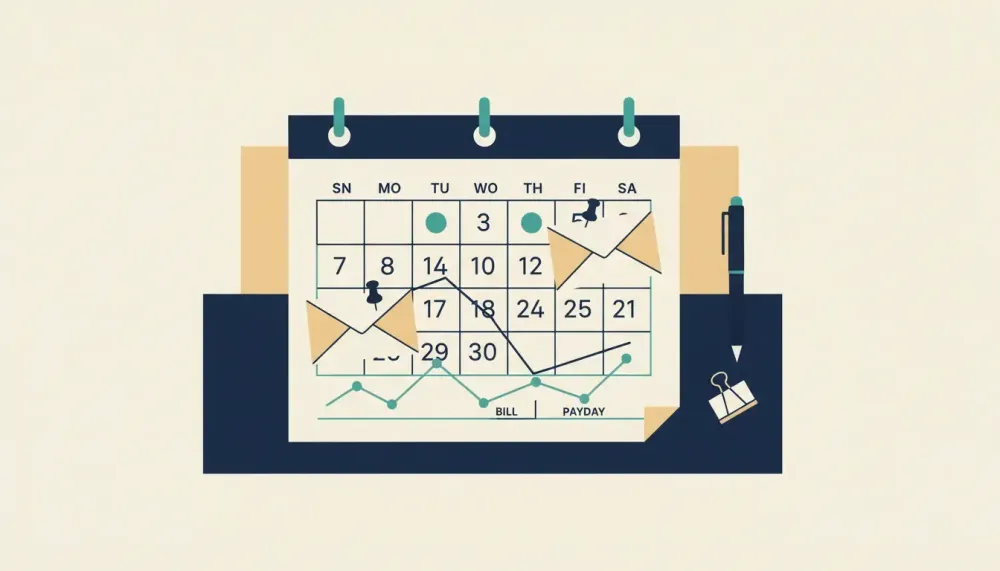
Jasmine works customer service at a national retailer. She's paid biweekly on Fridays by direct deposit. Her rent is due on the 1st and a few bills hit mid-month, so a bill often lands before payday. This paycheck calendar will map Jasmine's real paydays against her real due dates and show a projected daily balance so she can see the exact day money gets tight. She's also heard people talk about "three-paycheck months" and isn't sure what they mean for her. We'll walk through real dates from November 2026 to January 2027 and finish with a calendar view of income, bills, and a projected balance line.
Start here: what this solves and what you need
There is no universal US paycheck calendar. Your employer picks your paydays, and each biller sets its own legal due date. You have to map both yourself.
When you're done, you'll have a week-by-week and day-by-day view. It shows which paycheck covers which bill and the exact dates your projected balance dips.
That matters more than it sounds. According to a 2025 Federal Reserve Board report, 63 percent of US adults said in 2024 that they could cover a hypothetical $400 emergency with cash or its equivalent. Flip that around and more than a third could not. For a lot of people, one bill landing two days early is the emergency.
Gather these before you start:
- One recent paycheck date
- Your pay frequency, if you know it
- Every bill's due date and typical amount
- Today's checking balance
Later we'll sort out four dates that people mix up all the time. These are the employer's official payday, any early direct-deposit availability, the payroll processing date, and the bill's legal due date.
For Jasmine, the whole problem fits in one sentence. Rent is due on the 1st, and her Fridays almost never land on the 1st.
Find your paycheck schedule from one known payday
You don't need a year of pay stubs. One confirmed payday plus your frequency gives you every future date. After that you adjust for weekends and holidays, and your employer decides how those work. Some pay early, some pay late, so check your handbook or ask payroll.
Biweekly paycheck calendar: find your dates from one known Friday
Biweekly means every 14 days. Start from one Friday you know was a payday and keep adding 14.
Jasmine was paid on Friday, Nov 6, 2026. Her next dates:
- Nov 6, Nov 20, Dec 4, Dec 18, 2026
- Jan 1, Jan 15, Jan 29, 2027
Look at January. Three Fridays in that list fall inside one month. That's a three-paycheck month. A bi weekly paycheck schedule gives you 26 checks in most years, and since most months only fit two, most years have two three-paycheck months. Jasmine's 2027 has more. Her Fridays run from Jan 1 to Dec 31, so she gets 27 checks and three three-paycheck months: January, July (2, 16, 30), and December (3, 17, 31).
The third check isn't a raise. It's money you were always going to get, just bunched together. Jasmine's January 2027 is one of those months.
Semi-monthly: two fixed dates behave differently
Semi-monthly pay arrives on two set dates, 24 times a year. Two common patterns:
- The 1st and the 15th
- The 15th and the last day of the month
On a semi monthly paycheck calendar, the dates stay put but the weekday moves around. May 15, 2027 is a Saturday, so one employer pays Friday the 14th and another pays Monday the 17th. Only your employer can tell you which one applies to you.
Weekly: every 7 days, no three-paycheck month confusion
Weekly pay is the simplest. Take your known date and add 7 days, over and over.
A weekly paycheck calendar has no surprises, because every check is the same. You get 52 checks a year, sometimes 53. 2027 has 53 Fridays. Some months bring four checks and some bring five.
Set up your paycheck calendar step by step
Use paper, a spreadsheet, or an app. The steps are the same.
Step 1. Mark every future payday on a monthly calendar for at least the next three months.
Step 2. Add each bill on its legal due date. Flag anything on autopay, plus subscriptions, because those pull money without asking. Note grace periods only if you've confirmed them with the biller.
Step 3. Assign each bill to the paycheck that will pay for it. If a big bill lands before the next check, split it and set money aside from earlier checks.
Step 4. Add a running projected balance. Start with today's checking balance. Subtract each bill on its date and add each paycheck on payday. Circle every date where the balance gets uncomfortably low.
Worked example: a biweekly Friday schedule through a three-paycheck January 2027
Here's Jasmine's setup. These are example numbers, not a real person's account.
- Paychecks: $1,350 net on Nov 6, Nov 20, Dec 4, Dec 18, Jan 1, Jan 15, and Jan 29
- Starting balance: $3,100 on the morning of Nov 15
- Rent: $1,600 due Jan 1
- Car payment: $380 due Dec 20, a Sunday, so she funds it by Friday, Dec 18
- Utilities: $140 due Dec 28
- Phone: $80 due Jan 12
- Subscriptions: $45 on the 15th of each month
- Groceries: $150 every Saturday
- Gas: $60 every Wednesday
Assigning December bills. The Dec 4 check covers the Dec 20 car payment. The Dec 18 check covers the Dec 28 utilities. Groceries and gas come out of what's left over, plus the cushion she started with.
Pre-funding January rent. Rent is due on Friday, Jan 1, which is New Year's Day and a bank holiday. Her Jan 1 paycheck might not be there. So she has two options:
- Conservative plan: set aside $800 from the Dec 4 check and $800 from the Dec 18 check. Rent is fully covered before Dec 31 no matter what happens with the holiday.
- If she has confirmed early deposit: if her employer and bank have both told her the Jan 1 deposit will be available on Dec 31, she can set aside $800 from Dec 18 and $800 from the Jan 1 check.
We'd start Jasmine on the conservative plan. Early deposit is nice when it happens, but you can't pay rent with "it usually comes early."
Here's how her balance gets to the tight window. From Nov 15 through Dec 25 she receives three paychecks ($4,050). She pays two subscription charges ($90), five grocery runs ($750), six gas fill-ups ($360), two car payments on Nov 20 and Dec 20 ($760), utilities on Nov 28 ($140), December rent on Dec 1 ($1,600), and the phone bill on Dec 12 ($80). That's $3,100 plus $4,050 minus $3,780, so her balance is $3,370 on the evening of Dec 25. The $1,600 set aside for rent is sitting inside that number, so it isn't spending money.
Here's the day-by-day for Dec 26 to Jan 5:
- Sat Dec 26: groceries, minus $150. Balance $3,220
- Mon Dec 28: utilities, minus $140. Balance $3,080
- Wed Dec 30: gas, minus $60. Balance $3,020
- Thu Dec 31: pay rent one business day early to beat the holiday, minus $1,600. Balance $1,420
- Fri Jan 1: bank holiday. If her bank holds the deposit, nothing arrives. Balance $1,420
- Sat Jan 2: groceries, minus $150. Balance $1,270
- Mon Jan 4: the Jan 1 paycheck posts on the next business day, plus $1,350. Balance $2,620
- Tue Jan 5: no change. Balance $2,620
New Year's Day is a bank holiday. Plan as if the money arrives on the next business day unless your employer and your bank have both confirmed it will come earlier.
The lowest point is $1,270 on Jan 2. That's fine. The point is that Jasmine knows it's coming three days before it happens, not when she checks her app in the grocery store line.
The "extra" Jan 29 check. Before calling it extra, Jasmine looks at all of January. She brings in $4,050. She spends $3,235: the $80 phone bill, $45 in subscriptions, the $380 car payment, $140 for utilities, five grocery runs ($750), four gas fill-ups ($240), and $1,600 set aside from the Jan 15 and Jan 29 checks for Feb 1 rent. That leaves about $815. But a two-check month like February 2027 runs about $385 short, with $2,700 in and $3,085 out, including March rent. So roughly $430 is truly free to start a cushion.
One honest note. In these example numbers, Jasmine's weekly groceries and gas plus her fixed bills come to more than two paychecks in a typical month. Her starting cushion is quietly covering the difference. A projected balance shows you that kind of slow leak long before your bank does.
Semi-monthly and weekly pay: how your plan differs
With biweekly pay, you're matching moving checks to fixed bills. The other two schedules each make that easier in a different way. Pick the approach that matches your actual paycheck schedule, not the one your coworker uses.
Semi-monthly paycheck calendar: anchor bills to dates
Say you're paid on the 1st and the 15th. Bills due from the 1st to the 14th come out of the 1st check, like $1,600 rent on the 1st and an $80 phone bill on the 12th. Bills due from the 15th to the end of the month come out of the 15th check, like a $380 car payment on the 20th and $140 utilities on the 28th.
This is clean until a due date falls on a weekend or a holiday. If your biller hasn't clearly said it moves the date later, plan for the earlier business day.
Weekly paycheck calendar: think in one-week buckets
Each Friday's check pays for the Saturday to Friday week ahead. Groceries, gas, and anything due that week come out of that check.
Bigger bills need envelopes. Say rent is $1,600 and you get four checks before the 1st. Set aside $400 from each one. Five-check months give you a little room to spare.
Handle weekends and holidays the right way
Jasmine's problem isn't the amount. It's the date.
Keep these four dates separate:
- Employer payday: the official date your employer says you're paid
- Early direct-deposit availability: when some banks release funds ahead of payday
- Payroll processing date: when your employer sends the payment, usually before payday. Ask payroll for the exact lag.
- Legal due date: the date the biller considers the payment on time
Plan with the official payday. Treat early availability as a bonus you don't count on. Fund each bill at least one business day before its legal due date unless you've confirmed a grace rule for that specific bill.
Two examples:
- A credit card due on Sunday. Many issuers treat the next business day as on time, but confirm with yours. Fund it by Friday so you're covered either way.
- A landlord who wants rent on the 1st, period. Some landlords don't move the date for weekends. Fund it by the last business day before the 1st.
That second one is Jasmine. Her rent is due on a holiday Friday. Paying on Thursday, Dec 31, means it doesn't matter when her deposit shows up. Her car payment due Sunday, Dec 20 gets the same treatment, funded by Friday, Dec 18.
Plan for irregular income without breaking your calendar
Steady paychecks are the easy version. If your hours change or you earn tips, this is where standard budget advice tends to fall apart, because it assumes you know next month's income. You don't, so plan on the low side.
Here's the method we use:
- Look at your last three months of income. Say they were $2,900, $3,400, and $3,100.
- Use the lowest one, $2,900, as your baseline and schedule it as recurring income.
- Add anything above that as a one-off, and only after you've earned it.
- Don't assign rent or other must-pay bills to variable money until it has actually cleared.
Then set a cushion goal, like one paycheck or two weeks of spending. Fill it during three-paycheck months and surplus weeks. According to a 2025 Federal Reserve Board report, 55 percent of adults in 2024 said they had emergency or rainy day savings that could cover three months of expenses. That's a big goal. One paycheck is a reasonable place to start.
Jasmine's income is steady, but her holiday overtime isn't. The roughly $430 that's truly free in January is her first deposit toward that cushion.
See it in a calendar view with a projected balance using Cash Flow Calendar
We built Cash Flow Calendar because month-based budgets failed us when our income arrived in lumps. Cash Flow Calendar (2026) supports recurring income and expenses on weekly, biweekly, semi-monthly, monthly, or custom schedules, plus one-off entries.
For Jasmine, that means entering her pay once as biweekly from Nov 6, and the three-paycheck January shows up on its own. Rent, the car payment, and weekly groceries go in as recurring items. Overtime goes in as a one-off when she earns it.
The calendar view shows upcoming bills and income and projects the running balance for every future day. The $1,270 low on Jan 2 would be sitting right there on the calendar, weeks ahead.
Bank connection is optional. The same 2026 Cash Flow Calendar page notes that you can connect through Plaid in the United States and Canada to pull in real transactions and balances. You can also use manual entry for everything.
Common snags and how to fix them in your plan
- Bill before payday: split it and pre-fund it from earlier checks. Mark it as funded so you don't spend the set-aside money by accident.
- Autopay pulls at a surprise time: check each biller's weekend and holiday rule. Until you know, fund one business day early.
- Overdraft risk: pick a minimum checking floor, say $200. Subtract it once from today's balance and plan as if that money isn't there.
- Transfers between accounts: enter them as a bill on one side and income on the other, so both accounts' projected balances stay accurate.
Jasmine's $80 phone bill is due Jan 12. Her Jan 1 check posts on Jan 4, so the Jan 4 check covers it with room to spare.
Make this your last manual payday rewrite
Your calendar now shows which paycheck covers which bill and the exact day your balance dips.
Your next step: set this up in Cash Flow Calendar so you can see it in a calendar view with a projected balance for every day.

Written by
Philipp AlbrechtPhilipp Albrecht is the founder of Cash Flow Calendar. He spent years as a freelancer and built the app after missing a rent payment while waiting on client invoices — not because he didn't have the money, but because it hadn't landed yet. Everything on this blog comes from that problem: knowing what's coming in, what's going out, and on which day.
FAQs
Plan as if the deposit posts on the next business day unless both your payroll department and your bank have confirmed an earlier release. Pay any time‑sensitive bill on the prior business day so it is not dependent on the deposit timing. If that creates a gap, set aside part of the previous check to cover it. Ask payroll about their processing lag so you know how far in advance funds are sent.
Related Articles
Real Estate Agent Budget That Covers Bills Before Closings
Oct 28, 2026
What Is Irregular Income and How to Plan by Date This Month
Oct 26, 2026
How to Budget With Irregular Income and Avoid Cash Dips
Oct 25, 2026
Money Saving Budget Calendar That Boosts Savings Fast
Jun 30, 2026
How to Avoid Late Fees on Credit Cards Every Month
Jun 25, 2026
Credit Card Payment Calendar to Never Miss Due Dates
Jun 25, 2026
How to Schedule Automatic Payments Safely Without Overdrafts
Jun 22, 2026
Changing Bill Due Dates to Match Paydays Step by Step
Jun 22, 2026
Biweekly Paycheck Budget Calendar Guide and Template
Jun 21, 2026
How to use Recurring Transactions in a Calendar Budget
Oct 7, 2025

