
- 10 min read
Jasmine is a freelance graphic designer. Two client deposits hit one week, then nothing for ten days, and her $1,450 rent on the 1st keeps landing in the quiet. This is a plain-language map of freelance tax forms and a calendar you can actually use, so the tax dates stop ambushing your balance.
A new client just emailed Jasmine asking for a W-9. She realized she wasn't sure how the W-9, the 1099, Schedule C, and quarterly payments connect, or when any of them costs money.
Before you start: what this covers and how to use it
This maps each form to its stage, then puts the tax dates next to real paydays. It's general information, not tax advice, and dates shift for weekends and holidays, so confirm each year.
Jasmine's income arrives in lumps from direct clients and a design platform. If yours does too, the calendar parts matter more than the form names.
A quick map of freelance tax forms by stage
- Onboarding: you give a W-9 to a new client so they can report what they pay you.
- During the year: you invoice, keep records, and make estimated payments with Form 1040-ES if you expect to owe.
- January: you may get a 1099-NEC from clients, and possibly a 1099-K from platforms or payment processors.
- Tax time: you file Form 1040 with Schedule C and Schedule SE.
Your freelance income is taxable whether or not a 1099 ever arrives.
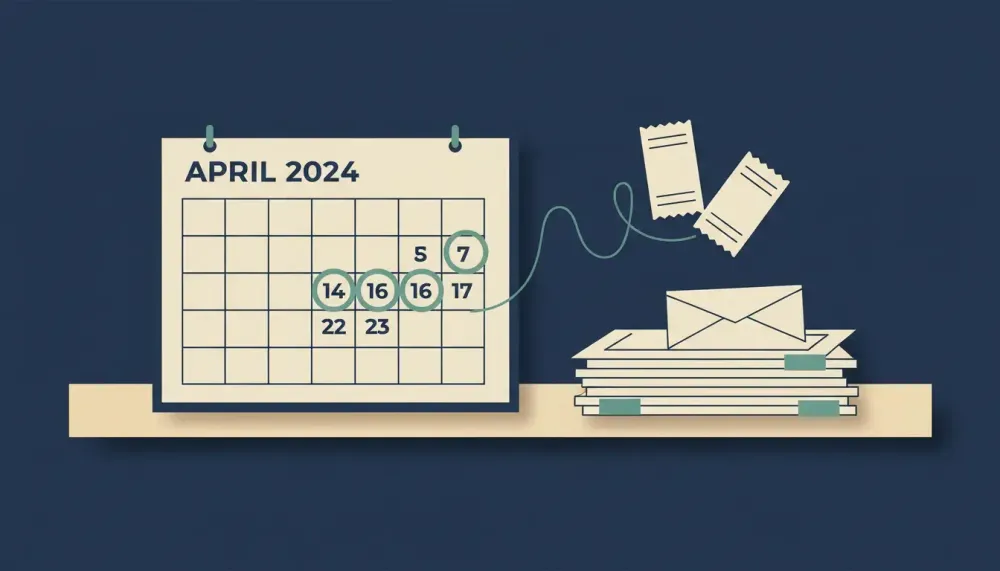
Take a $1,200 logo job Jasmine invoices in March. The W-9 goes out in March. If the client pays her in March, the tax on that money is part of the April 15 estimated payment. A 1099 might show up the following January, and the return is due the April after that. One job touches four dates across two calendar years.
W-9 for new clients: what you hand over and what it is not
Searched "w9 freelance" after an email like Jasmine's? It's the form your client needs for year-end reporting.
So she should send it right away, before the invoice is due, not after she notices the money hasn't arrived. Some clients won't release a payment until they have one on file.
A W-9 is something you give to the client. It isn't a bill, a payment to the IRS, or a tax. It collects your name, address, and taxpayer ID number so the client can report what they paid you.
Before she sends it, Jasmine checks four things:
- Name: her legal name on the name line. A business name, if she uses one, goes on the separate business name line.
- TIN: her Social Security number or EIN, typed correctly. One flipped digit causes headaches next January.
- Address: the one where she'll actually get mail in January.
- Signature and date: signed and dated with today's date.
Send it through a secure method if the client offers one. It holds your taxpayer ID, so treat it like a check, not a meme.
1099-NEC and 1099-K: what arrives in January and what to do if it does not
People often say "1099 freelance" like it's your filing form. It isn't. It's something a payer may send you.
Jasmine is likely to see two versions:
- 1099-NEC: reports nonemployee compensation a client paid you directly for your services.
- 1099-K: may report the total payments a platform or payment processor handled for you.
Both are information returns, not tax bills. Expect them by around January 31, and file your return using accurate totals from your own records, even if a form is wrong or missing.
Platforms add a wrinkle. A 1099-K may show your gross payments before the platform took its fees. On Schedule C you report your gross receipts, then deduct the fees as expenses. So a 1099-K that looks "too high" might just be showing money you never actually kept.
If a form is missing or wrong, Jasmine can send one of these:
- Missing: "Hi, I haven't received my 1099 for last year. Could you confirm the address and TIN you have on file and send a copy?"
- Wrong amount: "Hi, the amount on my 1099 doesn't match my records. Could you confirm the address and TIN you have on file and send a corrected form?"
Your return in one picture: Form 1040 with Schedule C and Schedule SE
Your business income and expenses go on Schedule C, and its net profit flows to your Form 1040. Self-employment tax is figured on Schedule SE, which also flows to your 1040, and half of it may be deductible as the law allows. Because nobody withholds tax from client payments, many freelancers pay estimated taxes during the year so the bill isn't one giant lump in April.
Say Jasmine bills a client $900 for a logo plus $300 for printing she paid for on their behalf. On Schedule C that's $1,200 of income and a $300 printing expense, alongside platform fees and software. Only the difference behaves like profit.
Estimated taxes with Form 1040-ES: how to figure a number and when to pay
The schedule is fixed even when your income isn't. According to the Internal Revenue Service (2026), Form 1040-ES divides the 2026 estimated-tax year into four payment periods, with payments due April 15, June 15, September 15, 2026, and January 15, 2027.
The periods aren't even quarters. The Internal Revenue Service (2026) lists them as January 1 to March 31, April 1 to May 31, June 1 to August 31, and September 1 to December 31. If a due date falls on a weekend or legal holiday, it moves to the next business day.
To pick an amount, start with a rough placeholder. This is an example, not a recommendation:
- Expected net profit for the year: $60,000
- Placeholder set-aside for combined income tax and self-employment tax: 25%
- Yearly set-aside: $60,000 × 25% = $15,000
- Per quarter: $15,000 ÷ 4 = $3,750
That 25% is a stand-in until you run the worksheet in Form 1040-ES or use an estimator. Your real rate depends on your deductions and household. State income tax, if any, may need its own set-aside. We don't know your numbers, and a flat percentage can be too high or too low.
With uneven income, set-asides will be uneven week to week. The quarterly target is what you're aiming at.
Turn the dates into a quarter-by-quarter calendar you can reuse
The base calendar for every year
- January: 1099s by January 31, the mid-January payment for the prior year's Q4, and receipts for last year's Schedule C.
- April: annual return and Q1 estimated payment around April 15.
- June: Q2 estimated payment around June 15.
- September: Q3 estimated payment around September 15.
- December: year-end expense review and W-9 details ready for new clients.
Worked example: one irregular quarter with real deposits and set-asides
Here's Jasmine's Q2 as an example. Her target for the June 15 payment is $3,750. Her deposits:
- Apr 3: $2,800
- Apr 19: $0 (the platform week where nothing cleared)
- May 6: $4,200
- May 28: $1,200
- Jun 7: $3,100
She moves 25% of each deposit to her tax account the day it lands:
- Apr 3: $700. Running total $700.
- May 6: $1,050. Running total $1,750.
- May 28: $300. Running total $2,050.
- Jun 7: $775. Running total $2,825.
On June 10 she checks in. She's at $2,825, which is $925 short of $3,750.
She's expecting a $2,000 invoice to clear on June 12. Setting aside 25% of that adds $500, bringing her to $3,325. That still leaves $425. On June 14 she tops up $425 from checking and reaches $3,750 before the June 15 due date.
One honest note: the IRS period for this payment ends May 31, so June deposits technically belong to the next period. But nothing stops you from using June cash to fund the June payment. The IRS cares about the payment. Your bank account cares about where the money comes from. The catch is that the June 7 and June 12 set-asides are now spent, so her pot for the September 15 payment starts at zero.
A week-by-week routine that fits freelance paydays
Every Friday, Jasmine spends about 20 minutes on four steps:
- Match deposits to invoices sent.
- Update year-to-date income and expenses so the estimate can be refined.
- Confirm the set-aside moved to a tax sub-account the day each deposit landed.
- Check upcoming bills and income and the next tax date, then adjust next week's set-aside if she's ahead or behind.
Step four is where collisions show up. Say her $1,450 rent is due Monday the 1st and her platform payout lands Wednesday. If she's behind on taxes, she can skip this Friday's top-up and make a bigger one after Wednesday, so rent and taxes aren't both drawing on the same thin balance.
Quick decision guide: which form fits which situation
- A new client wants your info before paying: give them a W-9.
- A client paid you for services: you may get a 1099-NEC. Report the income either way.
- You were paid through a platform or processor: you may get a 1099-K. Track your own gross receipts regardless.
- You're filing your annual taxes: Form 1040 with Schedule C, plus Schedule SE if self-employment tax applies.
- You're paying during the year: Form 1040-ES on the quarterly schedule.
For Jasmine this year, that means a W-9 for the new client now, four 1040-ES payments, and probably one 1099-NEC and one 1099-K next January.
Walkthrough: put tax dates and set-asides on a calendar view with a projected balance
The real question is what your balance looks like on each tax date. Here's how Jasmine sets that up in Cash Flow Calendar.
1. Add the tax dates. She adds her estimated tax payments as recurring entries on their due dates, using the $3,750 placeholder. If she expects to owe more when she files, she adds a one-off entry on the filing day.
2. Add the regular stuff. Her $1,450 rent goes in as a monthly bill on the 1st, with other bills on their schedules. Her platform payout goes in as weekly income on Wednesdays, at a conservative typical amount.
3. Add the lumps. Client invoices go in as one-off income on the dates she expects them to clear, like the June 12 invoice above.
4. Read the projected balance. In the calendar view, she scans upcoming bills and income and checks the projected balance around each tax date. In June, the payment on the 15th and rent on July 1 sit close together. If the balance dips too low around either date, she moves a planned set-aside earlier into a week she gets paid, or trims spending she can delay.
5. Connect a bank, or don't. She can connect her bank through Plaid to pull in real transactions and balances, or enter things by hand. Manual entry works fully on its own.
6. Separate business and personal if it helps. She can use multiple calendars, one for her design business and one for household bills, so tax set-asides don't get mixed in with groceries.
The calendar won't tell her what she owes. It shows her when cash is likely to be thin, while there's still time to do something about it.
When numbers do not match: missing, incorrect, or multiple 1099s and platform reports
Missing by early February. Email the payer, confirm the mailing address they have and that your W-9 is on file, and save the emails. Then file using your own records.
Incorrect. Ask for a corrected form, but keep filing on time using accurate totals from your books. A slow correction isn't a reason to miss the deadline.
Doesn't match platform reports. That's usually the gross-before-fees issue explained in the 1099 section above. A clean log matching each deposit to an invoice makes the difference easy to explain.
Multiple forms. If a client paid you directly and also through a platform, check that the same payment isn't counted twice. Your deposit log is how you tell.
Here's a common one. Jasmine's 1099-NEC from one client shows $24,000, but her books show $24,600 because a $600 December invoice was paid January 3. If she uses the cash method, she reports $24,000 on that year's return, writes a note tying the $600 to that January deposit, and includes it in next year's income.
The checklist and your first three actions today
- Fill in and save a current W-9 you can send on request.
- Put this year's four estimated tax dates and the expected filing date on your calendar, with a reminder the week before each.
- Pick a set-aside percentage based on last year's tax, or a conservative placeholder, and start moving that amount the day deposits land.
For Jasmine, the first real test is this Wednesday's platform payout. When it clears, 25% goes to the tax account that day, before rent can claim it.
Make taxes part of your rhythm, not a scramble
None of these forms are hard on their own. The trouble is timing. Jasmine's June 15 estimated payment lands two weeks before her $1,450 rent on July 1, and a quiet stretch or a payout that's two days late can squeeze both. That's fixable once she can see it coming.
Your next step is to put your upcoming bills and income, plus the four tax dates, into one calendar view and watch the projected balance around each due date. If you want a tool built for exactly that, you can see Cash Flow Calendar plans here.

Written by
Philipp AlbrechtPhilipp Albrecht is the founder of Cash Flow Calendar. He spent years as a freelancer and built the app after missing a rent payment while waiting on client invoices — not because he didn't have the money, but because it hadn't landed yet. Everything on this blog comes from that problem: knowing what's coming in, what's going out, and on which day.
FAQs
You can use your SSN, and many sole proprietors do. Getting an EIN is optional and free from the IRS, and it lets you give clients a business ID instead of your SSN. If you get one, use it consistently so year-end reports line up.
Related Articles
Paycheck Calendar To Map Paydays, Bills, And Balance
Nov 1, 2026
Real Estate Agent Budget That Covers Bills Before Closings
Oct 28, 2026
What Is Irregular Income and How to Plan by Date This Month
Oct 26, 2026
How to Budget With Irregular Income and Avoid Cash Dips
Oct 25, 2026
Money Saving Budget Calendar That Boosts Savings Fast
Jun 30, 2026
How to Avoid Late Fees on Credit Cards Every Month
Jun 25, 2026
Credit Card Payment Calendar to Never Miss Due Dates
Jun 25, 2026
How to Schedule Automatic Payments Safely Without Overdrafts
Jun 22, 2026
Changing Bill Due Dates to Match Paydays Step by Step
Jun 22, 2026
Biweekly Paycheck Budget Calendar: Handle 3-Paycheck Months
Jun 21, 2026
How to use Recurring Transactions in a Calendar Budget
Oct 7, 2025

