
- 14 min read
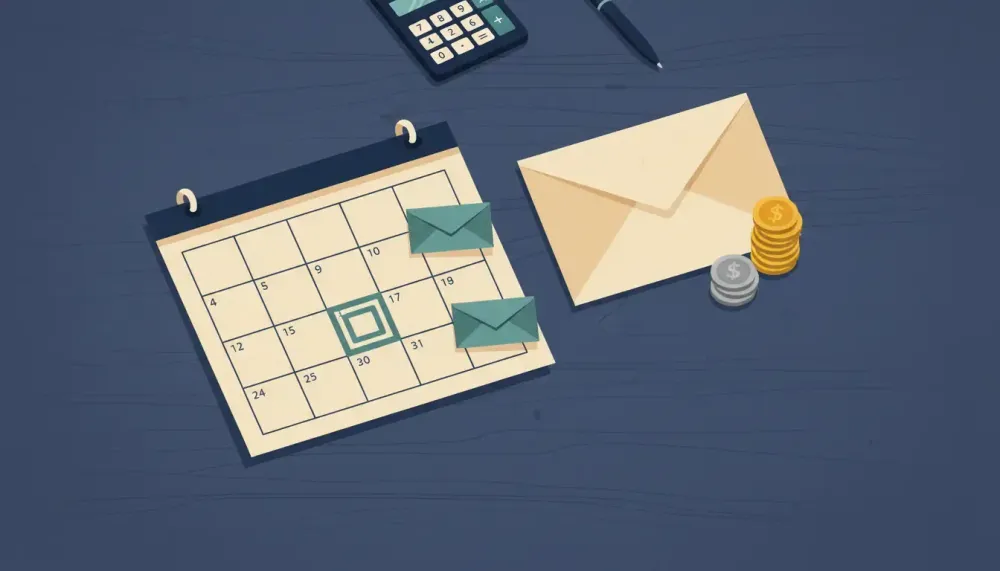
Jasmine, you're paid every other Friday, rent is due on the 1st, and the mid-month bills hit right when gas and groceries are already tight. So what happens when you get 3 paychecks in a month? It feels like bonus money, but the truth is it only helps if next rent and your week-to-week spending are covered first.
You run shifts at a retail store, your hours move a little every schedule, and you just spotted a month with three paydays on it. Your worry that the "extra" check will vanish is fair. We've watched it happen to our own money, which is why we stopped budgeting by the month and started budgeting by the date.
The quick answer: what happens when you get 3 paychecks in a month
Biweekly pay means 26 checks a year. Spread 26 checks over 12 months and two calendar months end up with three deposits. That third check isn't a raise. It's your same yearly pay, landing in a way that makes one month look generous.
Here's the short version. The third check frees up money only after next month's rent and your spending until the next payday are already set aside.
- First, set aside next rent or mortgage in full.
- Hold back weekly spending to carry you to the next payday after rent is due.
- Then assign any real surplus to savings, debt, or upcoming annual bills.
A quick timing example. Say the third check lands Friday, January 30, rent is due Sunday, February 1, and the next check won't arrive until Friday, February 13. That one deposit has to stretch across rent plus two weeks of groceries and gas. So do 3 paycheck months make a difference? They can. You just won't know how much until you've counted forward to February 13.
Do three-paycheck months actually make a difference?
Whether 3 paycheck months make a difference depends on which of two budgeting approaches you use. One plans as if every month has two checks. The other plans by the check, and by the date.
Say a household takes home $52,000 a year on biweekly pay.
- 24-check framing: $52,000 ÷ 24 = about $2,167 per check, if you plan as if two checks cover each month.
- 26-check reality: $52,000 ÷ 26 = $2,000 per check, with two months that bring three deposits.
If you plan around $2,167 a check, every real check comes up $167 short, and the two third checks just patch that hole. If you plan each month on two $2,000 checks, the third checks are real breathing room, but only after next rent and weekly spending are guarded. If you spread annual bills across all 26 checks, the month-to-month swing shrinks and the third check feels less dramatic.
So does a 3 paycheck month actually make a difference? It does when you treat it as a timing question. The Consumer Financial Protection Bureau's 2021 cash-flow budget tool suggests recording income and expenses by week, figuring each week's ending balance, and carrying that balance into the next week. Run a third-check month that way and you'll see what's actually spare.
How often do you get three paychecks in a month, and which months in 2025, 2026, and 2027?
On biweekly pay, you usually get three paychecks in two months a year. Which months depends on your first payday of the year and your payday weekday. If you get paid biweekly and want to know what months you get 3 paychecks in 2026 (or 2025, or 2027), find your first Friday below. Every-other-Friday pay has exactly two alignments each year, so these are the only two tracks. You only have to decide whether your first Friday check of the year is the first or the second Friday listed.
Three paycheck months in 2025
- First Friday paycheck Jan 3: January and August.
- First Friday paycheck Jan 10: May and October.
Which months have 3 paychecks in 2026
- First Friday paycheck Jan 2: January and July. December 2026 also has three (Dec 4, Dec 18, and Dec 31) if the Jan 1, 2027 check pulls ahead to Thursday, Dec 31.
- First Friday paycheck Jan 9: May and October.
Which months have 3 paychecks in 2027
- Track lined up to Friday, Jan 1: July and December if your employer pays the Jan 1 holiday check early, on Thursday, Dec 31, 2026. If it pays on Jan 1 instead, January 2027 also has three (Jan 1, 15, and 29), so the months are January, July, and December.
- First live Friday paycheck Jan 8: April and October.
That 2027 note changes 2026 for some people. On the Jan 2 track, a Dec 31 pull-ahead means December 2026 also gets three deposits (Dec 4, Dec 18, and Dec 31). If your employer pays Jan 1 instead, January 2027 gets three (Jan 1, 15, and 29).
Check your employer's 2025 to 2027 payday calendar for your exact track. Weekend and bank-holiday moves can shift deposit dates.
Three paychecks vs three pay periods: what your HR calendar is really counting
A month with three paychecks isn't always a month with three pay periods. Your bank counts deposits. HR often counts pay periods, the stretch of days you actually worked, and those start and end on different dates.
Here's a common setup on the Jan 2, 2026 track. Each period runs Monday through Sunday of the following week. Payroll is processed midweek, and the deposit lands Friday.
- Dec 15 to Dec 28, 2025: processed around Wednesday, Dec 31, deposited Friday, Jan 2.
- Dec 29 to Jan 11: deposited Jan 16.
- Jan 12 to Jan 25: deposited Jan 30.
Your bank sees three January deposits, but the first one paid for December hours. If HR counts periods by end date, January 2026 has only two. On that same track, May and November 2026 are the months with three period end dates (May 3, 17, and 31, then Nov 1, 15, and 29).
So if you're wondering which months have three pay periods in 2026, ask HR which date their calendar counts. For your bank balance, only the deposit date matters.
Worked example: a Friday biweekly schedule with real bills and weekly spending
Let's put numbers on it, Jasmine. These are example figures we picked, not your actual budget.
- Net pay: $1,600 per check
- Rent: $1,800 on the 1st
- Utilities: $220, due the 5th
- Car payment: $350 on the 15th
- Insurance: $160 on the 25th
- Weekly spending (groceries, gas): $300, set aside each Friday
Stable income example (2026 track with Jan 2 first payday: January and July)
Assume December's checks already paid the Jan 1 rent, and you start Jan 2 with $0 spare.
- Jan 2: paycheck +$1,600, spending -$300. Balance $1,300.
- Jan 5: utilities -$220. Balance $1,080.
- Jan 9: spending -$300. Balance $780.
- Jan 15: car -$350. Balance $430.
- Jan 16: paycheck +$1,600, spending -$300. Balance $1,730.
- Jan 23: spending -$300. Balance $1,430.
- Jan 25: insurance -$160. Balance $1,270.
- Jan 30: paycheck +$1,600. Balance $2,870.
That $2,870 looks like a windfall. It isn't yet. Rent on Feb 1 takes $1,800. Two weeks of spending before the Feb 13 check takes $600. The Feb 5 utilities bill takes $220. What's left is $250 of real surplus.
July works the same way. Deposits land July 3, 17, and 31, the same bills hit, Aug 1 rent is due, Aug 5 utilities follow, and the next check is Aug 14. Same math, same $250.
Here's the part we won't soften, Jasmine. In a regular two-check month on these numbers, $3,200 comes in and about $3,730 goes out ($730 in bills, $1,800 rent, $1,200 for four weeks of spending). That's roughly $530 short. These example numbers describe a budget that runs short every regular month. The $250 only exists because the example starts Jan 2 with rent already paid, so it's a one-time timing cushion, not a fix. If your real numbers look like this, the "behind on bills" section below is your plan.
When the third check is smaller (variable hours)
Say fewer shifts cut the Jan 30 check by 20 percent, to $1,280. Everything before Jan 30 stays the same, so the balance that day is $1,270 + $1,280 = $2,550.
Take out $1,800 for rent, $600 for spending, and $220 for Feb 5 utilities. You're $70 short. The surplus didn't shrink, it flipped. A smaller third check is exactly when planning ahead matters, because you can trim spending on Jan 30 instead of finding out on Feb 6.
Holiday shift example
In 2026, Friday, July 3 is the observed Independence Day for many employers, so some pay on Thursday, July 2. Starting July 2 at $0 spare:
- Jul 2: paycheck +$1,600, holiday weekend spending -$300. Balance $1,300.
- Jul 5: electric bill -$220. Balance $1,080.
- Jul 10: spending -$300. Balance $780.
- Jul 15: car -$350. Balance $430.
- Jul 17: next paycheck.
The early deposit covers the July 5 electric bill comfortably, but it adds zero dollars. It just makes the stretch to July 17 fifteen days instead of fourteen, right before a cookout weekend. Move the date in your plan. Don't move your expectations.
How to budget a three-paycheck month without coming up short
Cash flow is the timing of money coming in and going out. In 2019, the Consumer Financial Protection Bureau recommended reviewing it week by week if your household tends to run short. That's the whole idea behind how to budget a 3 paycheck month: dates first, amounts second.
The 4-step rule:
- First set aside enough from your three checks to cover the next rent or mortgage in full.
- Hold back a weekly spending reserve to carry you to the next non-three-paycheck payday.
- Cover any mid-cycle fixed bills that fall after the third check but before that payday.
- Only then assign remaining surplus to savings, debt, or upcoming annual bills.
The order matters, Jasmine, because each step protects a date that comes sooner or hurts more than the next. Rent is the biggest bill and lands two days after the third check, so it goes first. Spending is next because you eat every day. Surplus goes last because nothing breaks if it waits a week.
A bill calendar makes step 3 easy to spot. The Consumer Financial Protection Bureau's 2018 bill calendar tool puts bill dates and income dates side by side so you can compare each week's bills with each week's income. Mark Jan 30, Feb 1, Feb 5, and Feb 13 and the forgotten utilities bill jumps out.
Cover your next rent or mortgage first
The Jan 30 check is $1,600. Rent is $1,800. That's $200 short on its own.
The fix is the January leftovers. Before Jan 30, the balance was $1,270, so $200 of that tops up the rent fund. Now rent is fully covered, and $1,070 of the $2,870 remains.
Weekly spending reserve so you do not drain the account
From Jan 30 to Feb 13 is two weeks, so hold back $600. Here's how the reserve plays out:
- Jan 30: spending -$300. Balance $2,570.
- Feb 1: rent -$1,800. Balance $770.
- Feb 5: utilities -$220. Balance $550.
- Feb 6: spending -$300. Balance $250.
- Feb 13: next paycheck arrives with $250 still sitting there.
That $250 survived every date. That's how you know it's real.
What not to skip
Three deposits don't mean you can raid money set aside for bills that only show up once or twice a year. Common ones:
- Car registration
- Semiannual insurance premiums
- Annual memberships or software renewals
- Holiday gifts and school fees
Say you have a $300 premium every six months. That's $600 a year, about $50 a month, or roughly $23 per check across 26 checks. Keep sending that $23 from the third check too. The Consumer Financial Protection Bureau said in 2016 that saving ahead for expenses can help you handle them without skipping other bills or borrowing.
Save $2,000 in 3 months on biweekly pay: a per-check target that works
If you're wondering how to save $2,000 in 3 months on biweekly pay, count the checks first. A 3-month window usually holds 6 checks. If it includes a three-paycheck month, it holds 7.
- 7 checks: $2,000 ÷ 7 = about $286 per check.
- 6 checks: $2,000 ÷ 6 = about $334 per check (round up so you don't land a few dollars short).
The Consumer Financial Protection Bureau's 2021 cash-flow budget tool suggests turning a savings goal into a weekly or monthly amount and adding it to your budget. The per-check numbers here are our own arithmetic.
One catch. The 7-check math only works if the third check has $286 to spare. In our January example it has $250. Put $200 toward the goal and keep $50 as cushion, and the remaining $1,800 spread over the six regular checks is $300 each. On our example figures that $300 isn't available, because regular months already run $530 short. That plan only works if your real regular months break even, so check that before you trust it.
Plan it in a calendar view with a projected balance
Everything above is a running balance done by hand. The Consumer Financial Protection Bureau's cash-flow calendar guidance, in its 2026 toolkit, describes the same method: enter each day's sources and uses of cash, carry the balance forward, and calculate the weekly ending balance. Its 2018 bill calendar adds income dates next to bill dates so you can compare weekly totals.
We built Cash Flow Calendar to do that math for every future day. If you went looking for a 3 paycheck month calculator, we should be straight: this isn't a dedicated one. It shows your recurring paychecks and upcoming bills and income on a calendar view, with a projected balance for every future day, so a third check appears as one more deposit on the date it lands. Here's how Jasmine's January would be set up:
- Set a recurring biweekly paycheck on Fridays, starting from your first-payday track (Jan 2, 2026 here).
- Add monthly bills on their real due dates: rent on the 1st, utilities on the 5th, car on the 15th, insurance on the 25th.
- Add weekly spending as a recurring expense at $300. Child care or other custom schedules work too.
- Connect a bank through Plaid (United States and Canada) to pull in transactions and balances, or enter everything by hand. Manual entry works fully.
- On Jan 30, check the projected balance through Feb 13. In our example it settles at $250. That's the surplus you can assign to savings, debt, or an annual bill.
Multiple calendars let you keep personal and business cash flow separate. Budgets by category, transfers between accounts, and reports show where the money went. It runs on the web and on iOS and Android.
Edge cases and fixes: mixed-pay households, holidays, 27th paycheck years, and whether there are any more three-paycheck months left this year
- Mixed-pay households. If your partner is paid weekly or semimonthly (say the 15th and the last day), put both incomes and all shared bills in one plan to see the true surplus. If you track money separately, use separate calendars.
- Holidays and weekends. Move that paycheck to the observed deposit date in your plan, like July 2 instead of July 3, 2026. The every-other-Friday rhythm continues after it.
- Rare 27th paycheck year. On the Jan 2, 2026 track, if the Jan 1, 2027 deposit moves to Dec 31, your bank shows 27 deposits in 2026. If it doesn't move, 2027 gets 27 instead. Confirm with your employer, and redo any math that divides yearly income by 26.
- Any more three-paycheck months in 2026? On Jasmine's Jan 2 track, the three-paycheck months are January and July, plus December if the Jan 1, 2027 check pulls ahead to Dec 31. So after January, July is the next one, and December comes after it only if that pull-ahead happens. On the Jan 9 track, it's May and October. Put your recurring paychecks on a calendar view and you can see each deposit date laid out to check your count.
If you are behind on bills, how to handle a three-paycheck month
If you're catching up, here's how to handle 3 paycheck months safely:
- Catch up on current-month essentials first, so you avoid late fees or shutoffs.
- Build a small buffer, $300 to $500, before making extra debt payments.
- Then split any surplus 50/50 between high-interest debt and next month's essentials until you're fully current.
In our example, January's $250 surplus goes entirely to the buffer. July's $250 brings it to $500. Only after that does the 50/50 split start.
In 2019, the Consumer Financial Protection Bureau recommended setting aside what you can afford for common emergencies that might otherwise turn into costly debt. The $300 to $500 buffer and the 50/50 split are our rule of thumb, not CFPB figures. We don't know your interest rates or your landlord, so adjust if one bill carries a much bigger penalty than the others.
Close: Turn the third check into progress you can see
The third check stops being a guess once you can see the dates in front of you. Put your next two months of paydays and real due dates on a calendar view with a projected balance, so you can see exactly when surplus appears and decide where it goes. Your next step is to start a Cash Flow Calendar free trial and add your Friday paychecks first.

Written by
Philipp AlbrechtPhilipp Albrecht is the founder of Cash Flow Calendar. He spent years as a freelancer and built the app after missing a rent payment while waiting on client invoices — not because he didn't have the money, but because it hadn't landed yet. Everything on this blog comes from that problem: knowing what's coming in, what's going out, and on which day.
FAQs
Recompute what you must cover until the following deposit, including the next rent, utilities, and the daily spending you cannot skip. If the reduced check leaves a shortfall, delay nonessential spending, move scheduled savings to the next paycheck, and if possible transfer a small amount from a cushion or a credit card you can pay off quickly. Update your calendar so you can see the exact date when the next money arrives and avoid surprises.
Related Articles

Best Free Budget and Expense Tracker With Calendar
Nov 21, 2026
Is There a Calendar Template in Excel How to Find One Fast
Nov 19, 2026

How to Make a Simple Budget Spreadsheet That Flags Gaps
Nov 5, 2026
Freelance Tax Forms Explained and a Reusable Tax Calendar
Nov 4, 2026
Paycheck Calendar To Map Paydays, Bills, And Balance
Nov 1, 2026
Real Estate Agent Budget That Covers Bills Before Closings
Oct 28, 2026
What Is Irregular Income and How to Plan by Date This Month
Oct 26, 2026
How to Budget With Irregular Income and Avoid Cash Dips
Oct 25, 2026

Money Saving Budget Calendar To Schedule Dated Savings
Jun 30, 2026
How to Avoid Late Fees on Credit Cards in 15 Minutes
Jun 25, 2026
Build a Credit Card Payment Calendar in 10 Minutes
Jun 25, 2026

How to Schedule Automatic Payments Safely: A 30-Day Plan
Jun 22, 2026
Changing Bill Due Dates to Match Paydays in 6 Weeks
Jun 22, 2026
Biweekly Paycheck Budget Calendar: Handle 3-Paycheck Months
Jun 21, 2026
How to use Recurring Transactions in a Calendar Budget
Oct 7, 2025

