
- 12 min read
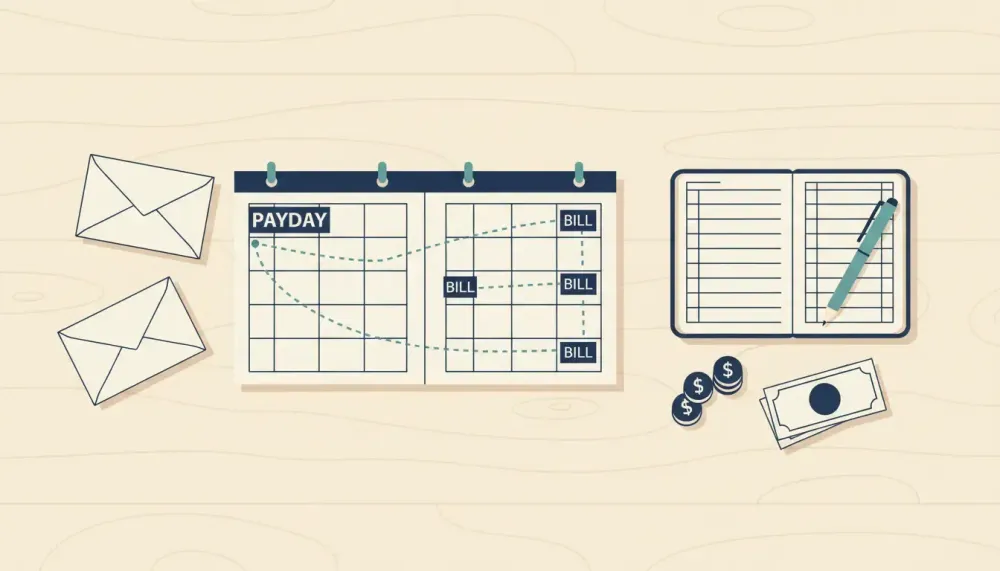
Jordan has a salaried job and gets paid every other Friday. Rent is due on the 1st, a $360 car payment hits mid-month, and a handful of subscriptions renew whenever they feel like it. Last month, several bills posted a few days before payday and Jordan nearly overdrafted, even though the month's budget looked fine. So for Jordan, how much buffer to keep in checking account isn't a guess. It's a question about timing.
A checking buffer is the cash that carries you across the short gap between a bill leaving and a paycheck landing. We'll show you a fast way to size it: a 60-day look at your actual paydays and due dates, using Jordan's numbers as the example.
First, know what a checking buffer is (and what it isn't)
A checking buffer covers timing gaps and small swings. An emergency fund covers big shocks, like a job loss or a blown transmission.
Two quick contrasts:
- Your cable bill posts three days early and lands the same week as two app renewals. That's a buffer problem, and the buffer absorbs it.
- You lose your job. That's not a buffer problem. It's the reason you keep an emergency fund in a separate account.
According to the Federal Reserve's 2025 report on household finances in 2024, 63% of U.S. adults said they would cover a hypothetical $400 emergency expense with cash or its equivalent, while 55% said they had rainy-day savings covering three months of expenses. A $400 surprise and three months without income call for different amounts of money, kept in different places.
Keeping them apart makes decisions simpler. For Jordan, the buffer only has to keep a Wednesday pileup of bills from bouncing before Friday's paycheck.
The fastest way to size your buffer: find your lowest projected balance over the next 60 days
Most buffer advice comes as a monthly rule: keep a month of expenses, keep a few hundred dollars, keep whatever your parents kept. The trouble is that bills and paydays rarely line up with a neat calendar month. If you're paid every other Friday, your paydays drift across the month, and some months get a third paycheck while rent stays exactly where it is.
A 60-day look fixes that. It catches bills that bunch up across the end of one month and the start of the next. It also catches the stretches where paydays sit far from the big bills.
Here's the one term you need. Your lowest projected balance is the smallest your running total will hit when you line up every known paycheck and bill by date over the next 60 days. It's not your average balance. It's your worst day.
A quick sketch: utilities come out Tuesday, two subscriptions hit Wednesday, and Friday's paycheck is still two days away. Wednesday night is your low point, even if the month as a whole is in the black. Money leaves midweek while the Friday paycheck waits.
Do it by hand in 15 minutes: a 60-day walkthrough with real dates and dollars
You need a pen and paper or a blank spreadsheet. The process has three steps:
- List every paycheck and bill by date for the next 60 days.
- Start with today's balance and add or subtract as each date arrives.
- Circle the lowest number.
Here's Jordan's version. Say Jordan starts at $1,850 on July 24 and takes home $1,250 per paycheck. Rent is $1,450 on the 1st, the car payment is $360 on the 15th, and utilities are $140 on the 7th. Subscriptions total $65 a month ($20 on the 3rd, $30 on the 12th, $15 on the 20th), and groceries and gas run $150 every Sunday.
- July 24: start at $1,850
- July 26: paycheck adds $1,250, balance $3,100
- July 28: groceries and gas take $150, balance $2,950
- Aug. 1: rent takes $1,450, balance $1,500
- Aug. 3: subscription takes $20, balance $1,480
- Aug. 4: groceries and gas take $150, balance $1,330
- Aug. 7: utilities take $140, balance $1,190
- Aug. 9: paycheck adds $1,250, balance $2,440
- Aug. 11: groceries and gas take $150, balance $2,290
- Aug. 12: subscription takes $30, balance $2,260
- Aug. 15: car payment takes $360, balance $1,900
- Aug. 18: groceries and gas take $150, balance $1,750
- Aug. 20: subscription takes $15, balance $1,735
- Aug. 23: paycheck adds $1,250, balance $2,985
- Aug. 25: groceries and gas take $150, balance $2,835
September repeats the same bills on the same dates. Rent and Sunday groceries both land on Sept. 1, dropping Jordan to $1,235, and the Sept. 3 subscription takes it to $1,215 before the Sept. 6 paycheck. After that, the balance stays higher through the end of the 60 days.
Circle the lowest number. Jordan's lowest projected balance is $1,190 on Aug. 7, with September's $1,215 a close second.
Here's why the low lands there. Rent on the 1st swallows most of the July 26 paycheck, and the next one doesn't arrive until Friday, Aug. 9. In between, a subscription, a grocery run and the utility bill keep chipping away. Rent on the 1st colliding with a paycheck on the 9th is the whole story.
Now run the same list starting at $600 instead of $1,850. Every balance drops by $1,250, and Aug. 7 lands at negative $60. That's the shape of Jordan's near miss: a month that works on paper, with one Wednesday that doesn't.
So what's the target? In the $1,850 version the low stays above zero, so Jordan's buffer is the floor Jordan wants to stay above on the worst day. Using the rule two sections down, that's a $200 swing amount (about 10% of Jordan's $2,015 in monthly bills) plus, say, a $50 account minimum, for $250. The projected low of $1,190 clears that by $940. In the $600 version, Jordan would need $60 to get back to zero, plus the $200 swing and the $50 minimum, or $310 more in the account before rent goes out.
What to do if your income is irregular
Same method, one change. Be pessimistic about money you don't control. Plan as if uncertain deposits arrive late, and size the buffer so you survive that version. This is where month-based budgets break. They broke for us when our own income arrived in lumps, and they kept saying we were fine right up until we weren't.
Scenario A, a freelancer. Say you start Aug. 1 with $1,700 and pay $1,450 rent that day. You spend $150 on groceries every Sunday and owe a $400 health insurance premium on Aug. 20. You expect two invoices to clear, $2,200 on Aug. 5 and $1,400 on Aug. 28.
If both arrive on time, your low is $100 on Aug. 4, the day before the first invoice clears. Tight, but positive.
Now push one payment out seven days. If the $2,200 slips to Aug. 12, you hit negative $50 on Aug. 11. If the $1,400 slips to Sept. 4, it's worse. September rent and groceries on Sept. 1 take you from $1,450 to negative $150, and you sit there until the payment clears. Size for the worse slip. That's $150 plus a swing of $185 (10% of $1,850 in monthly bills), or $335. Round it to $350.
Scenario B, a server. Say you get base pay plus tips, deposited weekly, and your last three weeks were $620, $560 and $440. Use the three-week average, $540, as your weekly income in the 60-day projection. Then add a "bad week" allowance to your buffer, equal to the gap between your average and your lowest recent week. That's $540 minus $440, or $100.
That $100 sits on top of the swing amount. In tipped work, a slow week is something to expect, not a fluke.
How much should my checking account buffer be? A simple rule for how much buffer to keep in checking account
Once you've found your lowest projected balance, the math is short.
- If your lowest projected balance dips below zero: your buffer is that shortfall (the number without its minus sign) plus a small swing amount. Add any bank account minimum on top.
- If your lowest never goes below zero: your buffer is the smallest balance you're comfortable staying above, plus any account minimum. If you don't have a comfort number, use your swing amount as the floor.
For the swing amount, take 5 to 10% of your monthly bills. It covers what you can't schedule, like a bill that runs high or a grocery week that gets away from you.
A micro-example: say your lowest day is negative $275 and your bills total $900 a month. At 10%, your swing is $90. Your target buffer is $275 plus $90, or $365. Round to $400 if you like clean numbers.
So how much cushion in a checking account is enough? Our answer: enough to cover your worst day, plus a little room. For Jordan, rent on the 1st with no paycheck until the 9th created the Aug. 7 low. In the $1,850 version that low stays positive, so the buffer is just the $250 floor. In the $600 version, that same low is what turned into a $310 top-up.
Use a calendar view to see your projected balance automatically (walkthrough)
Here's the same 60-day look in Cash Flow Calendar (cashflowcalendar.app):
- Add your recurring income and expenses on their real schedules. Weekly, biweekly, semi-monthly, monthly and custom schedules are supported, so Jordan's every-other-Friday pay goes in as biweekly.
- Enter one-off items, like an annual renewal or a single invoice.
- Look at the projected balance across the next 60 days in the calendar view, with your upcoming bills and income on their dates.
- Find the lowest date and read the number directly.
The math underneath is the same as the paper version. Cash Flow Calendar's balance forecast page (2026) describes the forecast as starting with the current balance, adding expected deposits on their dates, subtracting scheduled payments on their dates, and displaying the resulting projected balance. The same page says U.S. bank connections through Plaid can keep balances current. That connection is optional, and manual entry works fully without it.
The app also has multiple calendars (personal and business, for example), transfers between accounts, budgets by category, and reports. It runs on the web, iOS and Android. There's a free trial, then a paid subscription.
When is it "too much" in checking, and when to move cash to savings
Our rule of thumb: if your lowest balance in each of the last two pay cycles sat above your target buffer, you can move up to the smallest of those gaps to savings. That's our working answer to how much is too much in a checking account.
Before you move money, check a few tie-breakers:
- Interest: how much more savings actually pays than checking.
- Insurance limits: whether either account would go over FDIC or NCUA coverage.
- Minimums: whether moving money drops checking below a fee-free minimum.
- Big outflows: whether a known large bill is coming that you'd just move back for.
A quick example: say your target buffer is $1,600 and your lowest balance in each of the last two pay cycles was $2,300 or more. Move about $700 to savings.
For context, the Federal Reserve reported that 69% of adults in 2024 could cover an expense of at least $500 using only their current savings. Deciding how much to keep in checking vs savings isn't about emptying checking. It's about putting each dollar where it does its job.
For Jordan, the projected lows clear the $250 floor by $940 in August and $965 in September. That's two cycles on paper, so Jordan could move up to about $940 once the real account's lows confirm it.
Common rules you've heard, fact-checked quickly
Search for a checking account buffer on Reddit and you'll find answers ranging from $100 to two months of expenses. That spread is a sign of confusion, not a rule. Overdrafts are common enough to take seriously. In the Federal Reserve's report on 2024, 11% of bank-account holders said they paid an overdraft fee in the prior 12 months. That tells you the risk is real. It doesn't tell you a universal dollar amount.
The $27.40 rule. The version we see most often is saving $27.40 a day, which adds up to about $10,000 a year ($27.40 times 365 is $10,001). That's a savings target, not a checking buffer rule, and it doesn't know your paydays or due dates.
The $3,000 cap. The advice against keeping more than $3,000 in checking is about opportunity cost, since checking usually earns little. That's a fair point, but it isn't a safety limit, and there's no universal cap. Use your own buffer and the two-pay-cycle test above.
Keeping $10,000 in checking. It's only too much if it sits well above your personal buffer, plus any emergency cash you deliberately keep liquid, cycle after cycle. If it does, move the excess to savings.
Dave Ramsey. A common question: how much should I keep in my checking account with Dave Ramsey's approach? We haven't found one Ramsey dollar figure that fits every checking account. People also ask what bank account Dave Ramsey recommends. There's no one-size answer, and bank terms change, so check your own bank's minimums and features. Then size the float from your lowest projected balance.
Keeping the account open. How much you have to keep in checking to keep it open varies by bank and account type. Whatever your bank requires, that minimum sits on top of the buffer you calculated, not inside it.
Keep it working: how often to recalc and what to watch
A buffer is right for the bills you have today. Recalculate after any big change, like new rent, a new car payment, a new pay schedule, or a shift to variable hours.
Once a month, look at the next 60 days and confirm your lowest projected balance hasn't slipped below your target. It takes a few minutes, and it's a lot cheaper than an overdraft fee.
Watch for due dates that fall right before payday. Some lenders and utilities will move a due date if you ask, and a large bill can sometimes be split into two payments. Moving a bill from the 7th to the 10th can matter more than adding $100 to the buffer.
Here's how fast things shift. Say Jordan's new car insurance premium of $180 starts hitting on Aug. 6. The Aug. 7 low drops from $1,190 to $1,010, still above the $250 floor, but $180 closer to trouble.
The bottom line
The right checking buffer comes from your own lowest projected balance, not a number from a forum. Your target is the shortfall on your lowest day below zero plus a small swing amount, with your bank's minimum on top, or, if you never dip negative, the smallest balance you're comfortable with plus the minimum. Once you're consistently above that for two pay cycles, move the extra to savings.
You can do all of this on paper. If you'd rather not, Cash Flow Calendar says you can enter bills and income manually or connect a bank through Plaid in the United States and Canada, and that it runs on web, iOS and Android after a free trial.
Your next step: load your upcoming bills and income into a calendar and look at your lowest projected balance. If you want it done for you, try Cash Flow Calendar to see your projected balance and size your buffer from your lowest day. Start here.

Written by
Philipp AlbrechtPhilipp Albrecht is the founder of Cash Flow Calendar. He spent years as a freelancer and built the app after missing a rent payment while waiting on client invoices — not because he didn't have the money, but because it hadn't landed yet. Everything on this blog comes from that problem: knowing what's coming in, what's going out, and on which day.
FAQs
Plan for the late deposit scenario and size the cushion to cover the worst cash shortfall that would occur if a payment slips. Add a small buffer for routine variability equal to 5 to 10 percent of your monthly bills, plus whatever your bank requires as a minimum balance. Round up to a clean number so you have a simple target to maintain.
Related Articles

Best Free Budget and Expense Tracker With Calendar
Nov 21, 2026

What Happens When You Get 3 Paychecks in a Month Guide
Nov 20, 2026
Is There a Calendar Template in Excel How to Find One Fast
Nov 19, 2026

How to Make a Simple Budget Spreadsheet That Flags Gaps
Nov 5, 2026
Freelance Tax Forms Explained and a Reusable Tax Calendar
Nov 4, 2026
Paycheck Calendar To Map Paydays, Bills, And Balance
Nov 1, 2026
Real Estate Agent Budget That Covers Bills Before Closings
Oct 28, 2026
What Is Irregular Income and How to Plan by Date This Month
Oct 26, 2026
How to Budget With Irregular Income and Avoid Cash Dips
Oct 25, 2026

Money Saving Budget Calendar To Schedule Dated Savings
Jun 30, 2026
How to Avoid Late Fees on Credit Cards in 15 Minutes
Jun 25, 2026
Build a Credit Card Payment Calendar in 10 Minutes
Jun 25, 2026
How to Schedule Automatic Payments Safely: A 30-Day Plan
Jun 22, 2026
Changing Bill Due Dates to Match Paydays in 6 Weeks
Jun 22, 2026
Biweekly Paycheck Budget Calendar: Handle 3-Paycheck Months
Jun 21, 2026
How to use Recurring Transactions in a Calendar Budget
Oct 7, 2025

