
- 11 min read
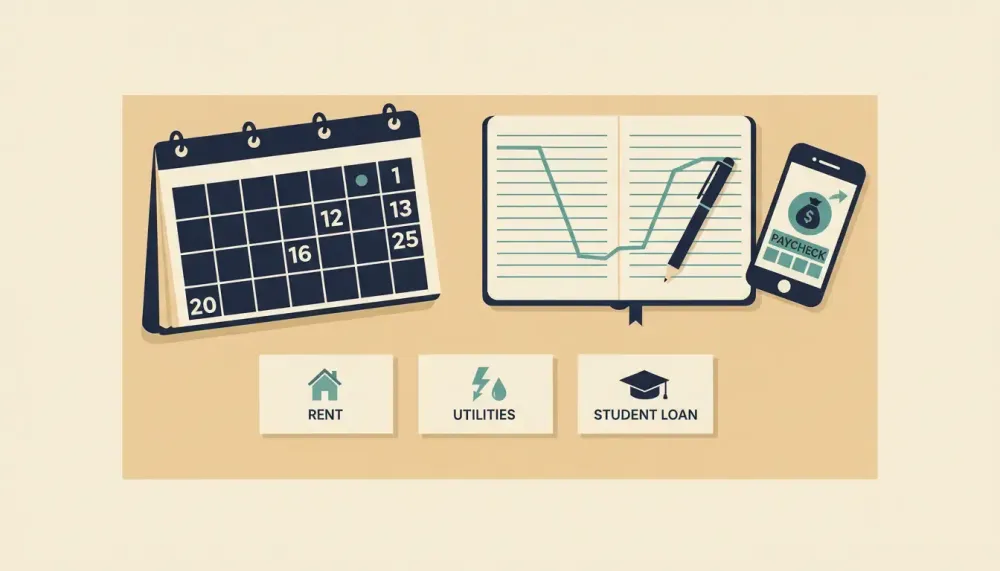
Meet Maya, a first-year marketing coordinator at a mid-size firm. She's paid on the 1st and 15th, picks up the occasional freelance design gig, and gets a bonus each quarter. Her rent, utilities, and student loan all hit by the 8th, so the week after rent is always tight. She wants budgeting tips for young professionals that do more than split money into buckets.
Most financial budgeting tips for young professionals stop at the monthly plan, and Maya's monthly plan is actually fine. So we're going to map her paydays against her due dates, forecast a running balance day by day, and find the exact day the dip happens so she can fix it before it does.
The problem isn't your budget categories. It's timing.
A monthly budget adds up everything you earn and everything you spend, then checks that the first number is bigger. It doesn't care that rent leaves on the 1st and your next paycheck shows up two weeks later. We learned this the hard way. Month-based budgets kept failing us when our income arrived in lumps.
Maya's forecast shows a balance of -$40 on the 6th, in a month where she ends up ahead overall.
She's not unusual. In a 2018 report on paying bills, the Consumer Financial Protection Bureau reported that 50% of consumers named a bill being due before they got paid as an important reason they fell behind, and 40% said the way they were paid didn't line up with their bills. We'd treat those exact figures with some care.
The fix is a different question. Not "do I have enough this month?" but "do I have enough on the 6th?"
Quick-start the basics so we can focus on timing
These are the budgeting tips for beginners we'd keep. Know your net take-home pay, meaning what actually lands in checking. Sort costs into essentials and wants. Then track one normal week of spending to spot leaks, like the $14 app you forgot about.
A common essentials list for someone in their 20s:
- Rent
- Utilities
- Phone
- Transit or car costs
- Groceries
- Debt payments, like a student loan
- Subscriptions you'd actually keep
- Savings
The 50/30/20 split (needs, wants, savings) is a fine checkpoint. It's not a rule, and it says nothing about when money moves.
Slack matters too. According to a 2025 Federal Reserve Board release (we couldn't find the exact figure on the page, so treat it as approximate), 63% of U.S. adults said in 2024 they could cover a hypothetical $400 emergency with cash or its equivalent, while 37% could not. If you're in that 37%, a bad week of timing hits harder.
Build a paycheck-timed map for the next six weeks
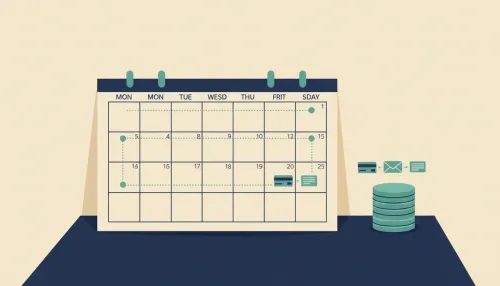
Write every payday and due date on the calendar day it actually happens. Add your weekly spending on its usual day. Then start with today's balance and do the math one day at a time. That running number is your projected balance.
The Consumer Financial Protection Bureau noted in 2018 that aligning bill due dates with income flow could help consumers manage cash flow and bills. You can't align what you can't see, so the map comes first.
Here's an example built on Maya's May 2026. Say she starts with $450, her rent is $1,625, and her weekly spending is groceries ($90 on Sundays), transit ($30 on Mondays), and fun money ($60 on Fridays).
- Morning of May 1: $450
- May 1 (Fri): paycheck +$1,650, rent $1,625, fun $60. Balance $415
- May 3 (Sun): groceries $90. Balance $325
- May 4 (Mon): transit $30. Balance $295
- May 5 (Tue): utilities $115. Balance $180
- May 6 (Wed): student loan $220. Balance -$40
- May 7 (Thu): nothing. Balance -$40
- May 8 (Fri): fun $60. Balance -$100
- May 10 (Sun): groceries $90. Balance -$190
- May 11 (Mon): transit $30. Balance -$220
- May 12 (Tue): car insurance $95. Balance -$315
- May 15 (Fri): paycheck +$1,650, fun $60. Balance $1,275
Here's the twist. If you keep going, May ends at $825, which is $375 more than it started with. On paper, Maya's month works. In real life, she's underwater from the 6th to the 14th. The 15th check feels like a raise, so it gets spent.
Run the map for six weeks, not two, so you catch the next month's crunch too.
Fix the dip before it happens: five levers that actually work
- Reserve from the prior paycheck. Leave $315 of the April 15 check untouched as a general cash reserve. That matches her May 12 low point of -$315, so it only gets her back to $0.
- Shift a due date. Ask the utility company to move the draft to the 10th. According to a 2018 Consumer Financial Protection Bureau report, changing due dates to better align with income could help some consumers manage cash flow. Some billers allow it, and the only way to know is to call and ask.
- Split the big bill. Build a rent reserve by earmarking $600 from the 15th of the prior month toward the next rent payment.
- Slow down for one week. Cut fun money from $60 to $20 on May 1 and May 8.
- Use a small buffer. Transfer $50 from savings to checking by the 4th, then pay it back on the 15th.
Maya builds her map on April 15, so she uses lever 3. Setting aside $600 from that check lifts every May balance by $600. Her lowest point becomes $285 on May 12. Because her second-half paychecks run a surplus anyway, she can keep doing this every month.
If she'd caught it on May 1 instead, after the April money was gone, she'd use patches: fun at $20 on May 1 and 8, the $50 buffer on May 4, and utilities moved to the 10th. That keeps her at $145 or higher through the 8th. Then groceries and the moved utilities land on the 10th and she's at -$60, falling to -$185 by the 12th. Patches buy days. The rent split fixes the month.
Budgeting tips for young professionals with variable or irregular income
Maya's salary is steady. Her freelance gigs and bonuses aren't. She's not alone there. According to the Federal Reserve Board's 2025 report, 11% of adults said in 2024 that they'd struggled to pay bills in the previous year because their income varied, up from 10% in 2023.
Build a minimum-income budget. For any variable income, average your lowest three months from the last 12. Say Maya's freelance income in her three slowest months was $0, $0, and $150. Her floor is $50 a month. Only the floor gets to pay for fixed commitments. Everything else is extra. Her quarterly bonus is above-floor money too, and it runs through the same five-step order.
When money comes in above the floor, use this order:
- Catch up any dip the forecast shows this period or next
- Build toward one month of core bills as a buffer
- Pay down high-interest debt
- Cover the next big known expense on your calendar
- Fund sinking funds
Say a $300 freelance invoice clears in a five-week month. Maya puts $120 toward week five's groceries and transit ($90 plus $30), $100 into her emergency fund, and $80 toward debt. That's all $300.
Week-by-week plan for four vs five-week months
Some months have five Fridays, or five Sundays, or both. If you budget weekly spending as if every month has four weeks, the fifth one shows up with no money attached. Our rule of thumb: pre-fund the extra week from the earlier check.
July 2026 has five Fridays (the 3rd, 10th, 17th, 24th, and 31st). Maya's July 1 check covers two of them. Her July 15 check has to carry three, plus everything through July 31.
So Maya keeps her fun budget at $240, the same as a four-Friday month. She caps fun at $40 on July 3 and July 10 and sets the $20 she saves each time aside. That $40 is her fun money for July 31. With $60 on the two middle Fridays, it adds up to $240.
What is the $27.40 rule? And should you use it?
People search for it, so here's our honest answer. We couldn't find a consistent, authoritative definition. Advice shared under that name varies from source to source, and it isn't an established budgeting framework that we can point you to.
That doesn't make every tip using the label bad. It just means we can't tell you what it is or whether it works. Test any rule you find against Maya's map: does it stop her -$40 on May 6? If it can't, it isn't solving a timing problem.
We'd rather point you to two methods that hold up: a paycheck-timed map that shows your projected balance by day, and a minimum-income budget built on your lowest reliable months.
We'd rather point you to two methods that hold up: a paycheck-timed map that shows your projected balance by day, and a minimum-income budget built on your lowest reliable months.
Prefer a calendar view with a projected balance? Here's how to do it in Cash Flow Calendar
Doing the math by hand works. It also gets old by week three. This is why we built Cash Flow Calendar.
The Cash Flow Calendar balance forecast starts with your current balance, adds expected deposits on their scheduled dates, subtracts scheduled payments on theirs, and shows the resulting balance over time. In practice:
- Add income and bills on their real schedules. Semi-monthly paychecks, biweekly pay, monthly rent, and weekly spending all work as recurring entries.
- Read the calendar view. Upcoming bills and income sit on the days they happen, with a projected balance for every future day.
- Spot the low day. You can see the exact date your balance would dip too low, then change a date or amount and see the new projected balance.
- Test one-off income. Add a freelance payment as a single entry and see what it does to the weeks ahead.
- Connect or don't. You can connect accounts through Plaid or enter transactions manually, according to Cash Flow Calendar. Bank connection is available in the United States and Canada. Manual entry works fully on its own.
- Keep money separate. If freelance and personal money live in different accounts, you can use multiple calendars.
When Maya enters her checks on the 1st and 15th, her $1,625 rent, utilities on the 5th, her loan on the 6th, and her weekly groceries, transit and fun money, the projected balance shows -$40 on May 6. That's the same dip from the hand-built map, minus the scratch paper.
Printable planner option for your first pass
If you searched for a budgeting for young adults pdf, you probably want something you can hold. Paper is fine. The timing method still works if you keep the running balance.
Here's how to set up one page:
- Top line: your starting balance and the date
- Left side: every day of the month, one per line
- Next to each day: money in, money out, and the running balance
- Highlight: paydays in one color, due dates in another
Make your first pass two weeks, May 1 to May 15 in Maya's case, using real numbers. Once that works, extend it to the full six weeks. If any line in the balance column goes negative, circle it and pick a lever. Maya would circle the May 6 row: student loan $220, balance -$40.
Keep it working: reviews, resets, and small automations
The map only helps if it stays current. Here's the upkeep we'd suggest:
- Weekly 10-minute check. Confirm upcoming bills and income for the next two weeks. Skim actual spending against the plan.
- Monthly 15-minute reset. Update any due date changes. Adjust your income floor if freelance work picked up or dried up. Reset your buffer target.
- Automations. The day after the 15th, move your $600 rent reserve into a separate savings account or label it in your bank's tools, if it offers that. Add a small automatic sweep to your buffer.
Maya set a phone reminder for the Thursday before her utilities draft on the 5th. It takes 30 seconds to glance at her balance and confirm the money is there.
The Reddit-style advice that actually holds up
If you've read the budgeting tips for young professionals reddit threads, you've seen the same advice a hundred times. Some of it fits the timing method well:
- Pay yourself first, but time it. Move savings right after payday, but only once the forecast shows no dip before the next check.
- Use sinking funds. Save a little each check for expenses that arrive in one lump, like a six-month car insurance premium (Maya pays hers monthly, so this is a general case) that could wreck one paycheck.
- Make a one-paycheck buffer your first big goal. For Maya, that's about $1,650 sitting in checking that she doesn't count as spendable.
Bigger goals can come later. According to the Federal Reserve Board's 2025 report, which we couldn't match to this exact figure on the page, 55% of adults said in 2024 that they had emergency savings to cover three months of expenses. That's a useful long-term marker, but a one-paycheck buffer solves the timing problem first.
Put your next two paychecks on the calendar and see where you'll dip
Put the next six weeks of your paydays on a calendar with your real due dates and weekly spend. If your projected balance dips below zero on any day, pick one lever and fix it today.
Maya's next move is small. Next time she sends a freelance invoice, she'll add it as a one-off on the date she expects it to clear and see how it changes the forecast before she spends a dollar of it.
Your next step is to build that six-week forecast in Cash Flow Calendar, see your daily projected balance, and test one timing change. Compare the monthly and annual plans on the pricing page to get started.

Written by
Philipp AlbrechtPhilipp Albrecht is the founder of Cash Flow Calendar. He spent years as a freelancer and built the app after missing a rent payment while waiting on client invoices — not because he didn't have the money, but because it hadn't landed yet. Everything on this blog comes from that problem: knowing what's coming in, what's going out, and on which day.
FAQs
Treat one-off income as targeted money: first plug any shortfall the day-by-day forecast shows, then add to a buffer that covers the next month of core bills, and only after that allocate to discretionary spending or debt paydown. Enter the expected deposit on your calendar or forecast so you can see the exact dates it prevents a negative day; if it arrives late, avoid spending it until the bank shows the cleared balance.
Related Articles
How Much Buffer To Keep In Checking Account 60-Day Rule
Nov 22, 2026

Best Free Budget and Expense Tracker With Calendar
Nov 21, 2026
What Happens When You Get 3 Paychecks in a Month Guide
Nov 20, 2026
Is There a Calendar Template in Excel How to Find One Fast
Nov 19, 2026
How to Make a Simple Budget Spreadsheet That Flags Gaps
Nov 5, 2026
Freelance Tax Forms Explained and a Reusable Tax Calendar
Nov 4, 2026
Paycheck Calendar To Map Paydays, Bills, And Balance
Nov 1, 2026
Real Estate Agent Budget That Covers Bills Before Closings
Oct 28, 2026
What Is Irregular Income and How to Plan by Date This Month
Oct 26, 2026
How to Budget With Irregular Income and Avoid Cash Dips
Oct 25, 2026
Money Saving Budget Calendar To Schedule Dated Savings
Jun 30, 2026
How to Avoid Late Fees on Credit Cards in 15 Minutes
Jun 25, 2026
Build a Credit Card Payment Calendar in 10 Minutes
Jun 25, 2026
How to Schedule Automatic Payments Safely: A 30-Day Plan
Jun 22, 2026
Changing Bill Due Dates to Match Paydays in 6 Weeks
Jun 22, 2026
Biweekly Paycheck Budget Calendar: Handle 3-Paycheck Months
Jun 21, 2026
How to use Recurring Transactions in a Calendar Budget
Oct 7, 2025

