
- 13 min read
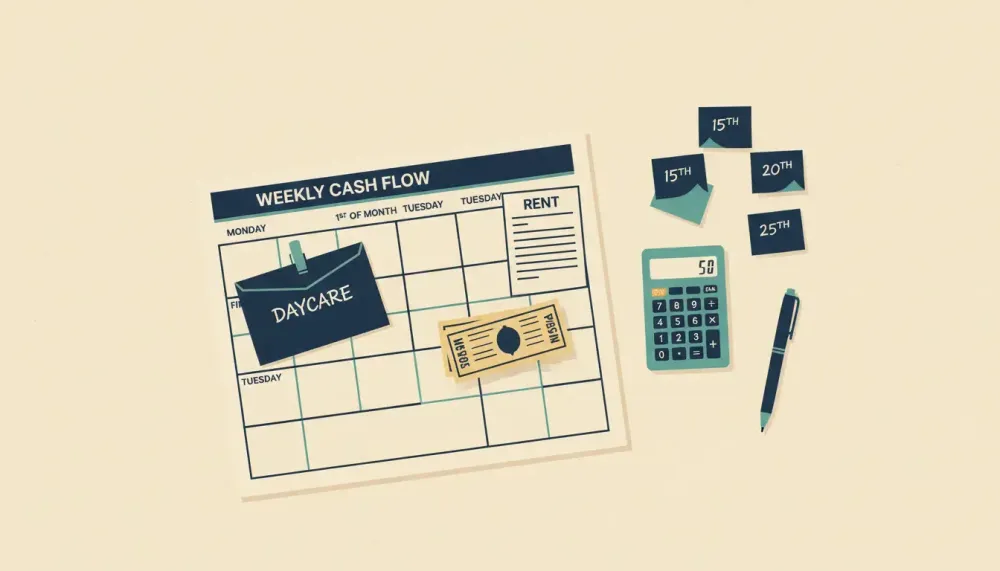
Renee's rent lands on the 1st. Daycare auto-debits every Monday. Her first paycheck of the month doesn't arrive until Friday, so Week 1 means refreshing the bank app and hoping. Renee is a shift supervisor paid every other Friday, with overtime that swings from check to check. Her partner Chris, a part-time home health aide, gets a direct deposit every Tuesday plus the occasional tip. These are the budgeting tips big families need when the monthly total looks fine but Week 1 dips below zero: a weekly cash flow calendar, and a plan that gives every bill its own paycheck.
They have four kids. Two are in elementary school and two are in daycare, which is why that Monday debit is $360. The trouble is the order things happen in, and that order keeps triggering overdrafts before the first Friday payday.
Start with your real paydays and due dates, not a monthly guess
A monthly budget puts all the income in one pile and all the bills in another, then compares the piles. If income wins, the budget says you're fine. It has no idea that rent leaves on Monday and the paycheck shows up on Friday.
We learned this the hard way when our own income arrived in lumps. A 2025 guide from the Consumer Financial Protection Bureau defines cash flow as the timing of money coming in and going out. It recommends tracking that timing so you don't run short before your next income arrives. Totals tell you whether the month works. Dates tell you whether Monday works.
Here's the start of Renee and Chris's month, written by date:
- Mon 1: rent $1,650, daycare $360, school lunches $50
- Tue 2: Chris's deposit
- Fri 5: Renee's paycheck
- Mon 8: daycare $360, school lunches $50
- Mon 15: electric $140, daycare $360, school lunches $50
- Fri 19: Renee's paycheck
In the example month below, they bring in $6,000 at a careful estimate and spend $5,810. That leaves $190 to spare. But Monday the 1st alone asks for $2,060, and no new paycheck arrives before it. A monthly budget would call this family fine. Their bank would call it an overdraft.
Build a weekly cash flow calendar in 20 minutes
You need paper, a pencil and every bill you can find. A spreadsheet works too, but paper is faster the first time because you can scribble.
The Consumer Financial Protection Bureau's 2018 bill calendar tool uses the same idea: enter income dates and amounts, list bills on their due dates, then compare each week's bills with that week's income. Here's our version:
- Write out next month's dates, grouped into weeks.
- Add every payday, with a floor amount for each check. The floor is what you're confident you'll get in a slow week, not what you got the week overtime was great.
- Add every bill and weekly cost on its real date. That includes daycare every Monday, school lunch reloads, and weekly envelopes for groceries and gas.
- Next to each item, pencil which paycheck will cover it. Write "Renee, Fri 5" or "Chris, Tue 9" right beside it.
- Circle any week where money going out beats money coming in. Star any bill with no paycheck in front of it.
Step 4 is the one most budgets skip, and it's where the trouble shows up. If a bill can't be matched to a paycheck that arrives before it, you've found your overdraft ahead of time.
A 2025 bill calendar guide from the Consumer Financial Protection Bureau advises using a conservative estimate for variable income. It also suggests asking for a due date change when a bill falls a week or more before the income meant to cover it. For big families, we'd go further. When Monday debits run $400 or more, even three or four days can matter.
Case study: a family of six builds next month's calendar and avoids a Week 1 shortfall
We'll use February 2027 for Renee and Chris. It starts on a Monday and runs exactly four weeks, which makes it the tidiest month you'll ever meet. Your month won't be this neat. A five-Monday month adds another $410 in daycare and lunches, so check how many Mondays next month has before trusting the monthly total. The method still works.
Every number here is an example we built to look like a real family of six. Swap in your own.
Income floors:
- Renee: $2,100 every other Friday (Feb 5 and Feb 19)
- Chris: $450 every Tuesday (Feb 2, 9, 16 and 23)
Bills:
- Rent $1,650 on Mon 1
- Daycare $360 every Monday
- Car insurance $180 on Wed 10
- Credit card $150 on Thu 11
- Electric $140 on Mon 15
- Internet $70 on Sat 20
- Phone $120 on Mon 22
Weekly costs:
- Groceries $300 and gas $120, pulled into envelopes on Renee's paydays, two weeks at a time
- School lunches $50, every Monday
- Sinking funds $45 a week (Christmas $20, back to school $15, car registration $10)
Here's which paycheck covers what:
- Renee, Jan 8 and Jan 22: $825 each into savings, so February's rent was ready early. On Fri Jan 29, they moved the $1,650 back to checking.
- Chris, every Tuesday: next Monday's daycare and lunches ($410). The extra $40 stays in checking. His Jan 26 deposit covers Feb 1.
- Renee, Fri 5 ($2,100): $825 toward March rent, $840 for Weeks 2 and 3 groceries and gas, $90 to sinking funds, $180 car insurance, $150 credit card. Left over, $15.
- Renee, Fri 19 ($2,100): $825 toward March rent, $840 for groceries and gas through the first week of March, $90 to sinking funds, $70 internet, $120 phone. Left over, $155.
See the problem? The $140 electric bill on Mon 15 has no paycheck in front of it. Friday the 5th is spent down to $15, and Friday the 19th arrives four days too late.
The running balance confirms it. They start Sunday, Jan 31 with $2,100 in checking (the $1,650 rent plus Chris's $450).
- Mon 1: $40 after rent, daycare and lunches
- Tue 2: $490
- Fri 5: $835 after Renee's check and its assignments
- Mon 8: $425
- Tue 9: $875
- Thu 11: $545 after car insurance and the credit card
- Mon 15: $5 below zero after daycare, lunches and electric
Five dollars short still counts as short. So Renee calls the electric company and asks to move the due date from the 15th to the 20th, the day after her paycheck. Some companies say yes, some say no, and finding out costs one phone call. Say this one says yes. Now Friday the 19th covers electric too, leaving $15.
The new projected balances:
- Mon 1: $40. Week 1's low point, tight but above zero.
- End of Week 1 (Sun 7): $835
- End of Week 2 (Sun 14): $545
- Mon 15: $135
- Tue 16: $585
- Fri 19: $930
- Sat 20: $720
- End of Week 3 (Sun 21): $720
- Mon 22: $190 after daycare, lunches and phone
- Fri 26: move $1,650 from savings to checking for March rent
- End of Week 4 (Sun 28): $2,290, which includes $1,650 for March rent
Each week's low point is Week 1, $40 (Mon 1); Week 2, $425 (Mon 8); Week 3, $135 (Mon 15); and Week 4, $190 (Mon 22). Week 2 is their roomiest week. Week 3 is still tight.
Compare that to the old way: without the rent split, Sunday, Jan 31 would have held only Chris's $450, and Monday's $2,060 would have pushed them $1,610 below zero.
This follows a 2022 savings booklet from the Consumer Financial Protection Bureau: start with your balance, record income and expenses on the days you expect them, and move expenses to weeks with more income when you can. A 2025 report on overdraft from the Consumer Financial Protection Bureau found that assigning specific bills to each paycheck is one strategy people use when cash flow is tight. Renee and Chris didn't earn more in February. They just stopped asking Monday to pay for Friday's money.
The budgeting tips big families are rarely told
Most advice for large families is about spending less. That helps, but it doesn't fix a Monday debit that lands before payday. These habits do more for timing:
- Split housing in half and stash it early, so $825 from each of two checks is sitting there on the 1st.
- Move due dates by 3 to 5 days, as moving electric from the 15th to the 20th fixed Renee and Chris's whole month.
- Keep a $300 buffer in checking after Monday's debits, in case a Tuesday deposit the week before comes in short.
- Fund sinking funds weekly, in small amounts, since $20 a week for Christmas is $1,040 by year's end.
- Use weekly envelopes for groceries, gas and kid costs, with any daily caps set inside the envelope.
The same CFPB guide says to watch your checking balance before automatic transactions, because insufficient funds can mean overdraft fees. Daycare auto-debits are the classic case. They don't check with you first.
Handle variable and extra income without breaking the plan
Plan on a floor, not an average. We use about 80 percent of a typical check. Say Renee's checks usually run $2,625 with overtime. Eighty percent of that is $2,100. Chris's weeks average about $565, so 80 percent is $452, rounded down to $450.
Then compare the 80 percent figure with your lowest check in the last few months, and plan on whichever is lower.
That matches a 2025 bill calendar guide from the Consumer Financial Protection Bureau, which says to estimate variable income using an amount you feel confident you'll receive. We can't tell you your exact floor. Your last few months of pay stubs can.
When extra money shows up, it needs a job before groceries quietly absorb it. Here's our order:
- Top up this week's daycare or essentials.
- Cover the next bill that has no paycheck in front of it.
- Build the one week checking buffer.
- Add to sinking funds.
- Pay extra on debt.
Say Renee's Fri 19 check comes in at $2,300 instead of $2,100. This week's essentials are covered, and after the electric move, every bill has a paycheck. So the $200 drops to step 3. Monday the 22nd was projected to end at $190 after $530 in daycare, lunches and phone. Renee and Chris want at least $300 left after Monday debits, so they keep $150 in checking. Monday now ends at $340. The other $50 goes to Christmas.
The same CFPB guide suggests using weeks with more money to move extra into savings after you've covered cash flow needs.
Benchmarks people ask about
We don't have research to cite for these, so treat everything below as rules of thumb and our own math.
What is the 50/30/20 rule for families?
It splits take-home pay into 50 percent needs, 30 percent wants and 20 percent savings or debt. It's a quick check, not a rule you've failed.
Run it on Renee and Chris's February. Their needs (rent, daycare, groceries, gas, lunches, insurance, electric, internet and phone) total $5,480. That's about 91 percent of their $6,000 floor, a long way from 50.
When daycare ends, their needs drop by $1,440 to $4,040, or about 67 percent. That's close to 65/20/15, a split that is a more honest target for some families with young kids. 50/30/20 is a later step, if it ever comes.
That $1,440 drop assumes nothing replaces daycare. After-school care or two more lunch accounts would eat into it. Until then, the percentages describe a season, not a grade.
What is the $27.40 rule?
As far as we can tell, this isn't a widely accepted budgeting standard. We've seen it online as a daily savings target ($27.40 a day comes to $10,001 over a year) and as a daily spending cap. For Renee and Chris, saving $191.80 a week isn't realistic right now, when their whole month has a $190 surplus.
As a spending cap, it works better weekly. If Renee and Chris's $300 grocery envelope and $50 in school lunches add up to $350 a week, that's $50 a day on average. But you still manage it as one weekly envelope, so you can do one big Saturday shop without "breaking" Tuesday's cap.
What big families on Reddit say works
Searching "budgeting tips big families reddit" turns up the same themes again and again. They're useful once each one has a spot on the weekly calendar:
- A weekly Christmas sinking fund, so December doesn't swallow January
- Bulk buying only after a unit price comparison, and only in a week with room
- Rotating the pantry so older food gets eaten first and less gets thrown out
- Library passes for free museum and zoo days, planned for tight weeks like Week 1
See it in a calendar view with a projected balance
Paper works. The catch is that one change, like electric moving to the 20th, means redoing every balance after it. A cash flow calendar app takes that redo off your plate.
The Consumer Financial Protection Bureau's 2018 bill calendar materials recommend placing income and bills on their actual dates, so you can compare weekly inflows and outflows and see when cash will fall short. Cash Flow Calendar is built on that idea. It shows upcoming bills and income in a calendar view and tracks a projected balance for every future day.
For Renee and Chris, setup would look like this:
- Weekly: daycare $360 and lunches $50 every Monday, Chris's $450 every Tuesday
- Biweekly: Renee's $2,100 every other Friday, along with her $825 rent set-aside
- Monthly: rent $1,650 on the 1st, electric $140 on the 20th, plus the other bills on their real dates
- One-off entries: a field trip fee, a pediatrician copay, a surprise overtime bump
The calendar view then shows the projected balance for each day. Without the rent split, Monday the 1st would show the $1,610 shortfall from the case study. With recurring daycare Mondays entered and rent split across two checks, Feb 1 sits at $40 instead. It's thin, but it's above zero, and they can see it weeks ahead.
If you'd rather not type every transaction, there's an optional bank connection through Plaid (United States and Canada) to pull in real transactions and balances. Manual entry works fully without it. And if Chris wants his tips tracked apart from household money, he can keep a separate calendar.
Free tools and tips for big families
You can start tonight without spending anything. The Consumer Financial Protection Bureau offers free downloadable tools as of 2026, including a bill calendar, a spending tracker, a tool for prioritizing bills, and cash flow budget materials. Its 2026 bill calendar instructions walk you through listing every bill, recording its payment date and adding income dates, so you can see how they line up.
Prefer a spreadsheet? Make four columns: date, income floor, bills assigned, remaining. Renee's Fri 5 row would read $2,100 in, $2,085 assigned, $15 remaining.
A sinking fund checklist for a big family:
- Birthdays (with six people, that's six a year)
- School fees and field trips
- Sports and activity fees
- Holidays
- Insurance bills that come yearly or twice a year
- Car maintenance and registration
Quick wins:
- Ask for a due date change on any bill that lands just before a payday.
- Set autopay to pull the day after a paycheck, not the day before.
- Give kid medical and pharmacy costs their own weekly envelope, even if it's only $15.
Make next week safer, then repeat
The calendar only helps if you look at it. The same CFPB guide recommends checking cash flow, due dates and balances regularly, because timing mismatches can leave you short before the next income arrives. A 2017 post from the Consumer Financial Protection Bureau adds that a bill calendar helps you see your heaviest payment weeks and negotiate a due date when a bill keeps arriving before your income.
Our 15 minute Sunday reset:
- Confirm which deposits are coming this week, and when.
- List every bill and auto-debit that hits.
- Fill the weekly envelopes.
- Check that Monday's daycare is covered by money already in checking.
- If you use a calendar app with a projected balance, make sure no day this week drops below your buffer.
Here's Renee and Chris on Sunday, Feb 14. Checking shows $545. Monday takes $410 for daycare and lunches, and electric now waits until the 20th. That leaves $135, below their $300 goal but above zero. Chris's $450 lands Tuesday. Renee skips the Sunday drugstore run, because she can see that $135 a day early instead of on an overdraft notice.
Your next step: build next month's bill calendar on paper tonight and assign each bill to a paycheck. If you want the calendar view and projected balance done for you, set it up in Cash Flow Calendar to see your balance for every day and catch low balance dates early.

Written by
Philipp AlbrechtPhilipp Albrecht is the founder of Cash Flow Calendar. He spent years as a freelancer and built the app after missing a rent payment while waiting on client invoices — not because he didn't have the money, but because it hadn't landed yet. Everything on this blog comes from that problem: knowing what's coming in, what's going out, and on which day.
FAQs
Call the company and request a payment date that follows your paycheck, or ask for a different billing day if available. If that is not possible, earmark a portion of an earlier deposit into a separate holding account or a labeled transfer so the amount is already waiting when the debit runs. Keep a small checking cushion to cover timing slips while you test the new arrangement.
Related Articles
6 Budgeting Tips For Young Professionals Using Pay Timing
Nov 23, 2026
How Much Buffer To Keep In Checking Account 60-Day Rule
Nov 22, 2026

Best Free Budget and Expense Tracker With Calendar
Nov 21, 2026

What Happens When You Get 3 Paychecks in a Month Guide
Nov 20, 2026

Is There a Calendar Template in Excel How to Find One Fast
Nov 19, 2026

How to Make a Simple Budget Spreadsheet That Flags Gaps
Nov 5, 2026

Freelance Tax Forms Explained and a Reusable Tax Calendar
Nov 4, 2026
Paycheck Calendar To Map Paydays, Bills, And Balance
Nov 1, 2026

Real Estate Agent Budget That Covers Bills Before Closings
Oct 28, 2026
What Is Irregular Income and How to Plan by Date This Month
Oct 26, 2026

How to Budget With Irregular Income and Avoid Cash Dips
Oct 25, 2026

Money Saving Budget Calendar To Schedule Dated Savings
Jun 30, 2026

How to Avoid Late Fees on Credit Cards in 15 Minutes
Jun 25, 2026
Build a Credit Card Payment Calendar in 10 Minutes
Jun 25, 2026

How to Schedule Automatic Payments Safely: A 30-Day Plan
Jun 22, 2026
Changing Bill Due Dates to Match Paydays in 6 Weeks
Jun 22, 2026

Biweekly Paycheck Budget Calendar: Handle 3-Paycheck Months
Jun 21, 2026
How to Use Recurring Transactions in a Calendar Budget Today
Oct 7, 2025

