
- 12 min read
Maya is a freelance social media manager who gets paid when invoices clear, not on a neat schedule. Her car payment and car insurance both hit on the 15th, and last month a late client payment almost pushed her into an overdraft. These budgeting tips for ADHD trade monthly guesswork for a simple weekly calendar that tells you what you can spend today.
We started building cash flow tools because month budgets failed us when our own income arrived in lumps. We're not clinicians, and we won't pretend to know how ADHD works in your head. What we can offer is a method built around dates, short check-ins, and as little mental math as possible.
Why monthly budgets break down when your income and brain are both variable
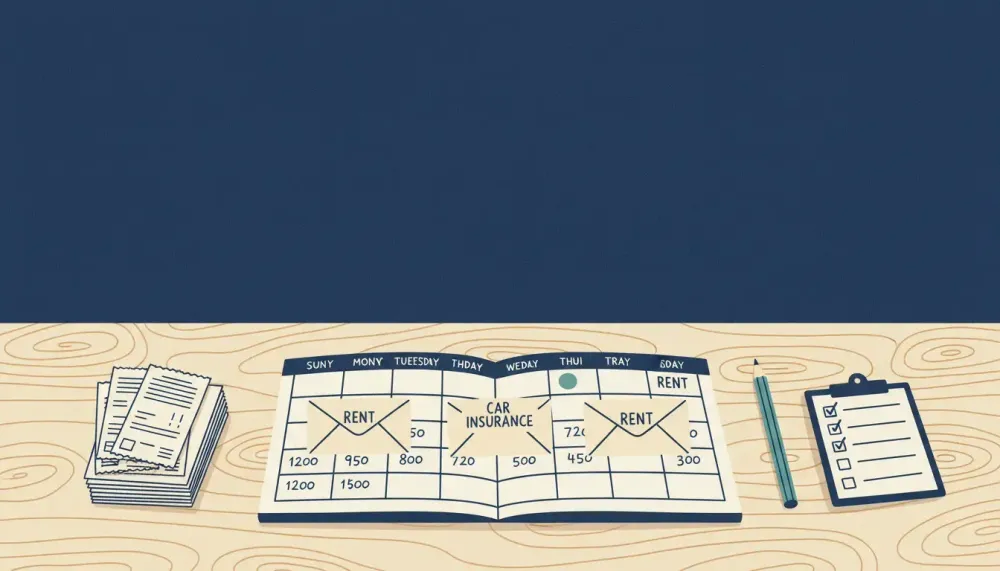
Maya's invoices and platform payouts land on Tuesdays and Fridays. Her bills ignore that schedule and cluster on the 1st and the 15th. What she wants is one number each morning that she can trust.
A monthly budget asks one question: did more come in than went out? Say Maya's May shows $4,000 in and $3,600 out. On paper she's fine.
But if her $1,450 rent is due on the 1st and her next invoice clears on the 6th, she spends five days short. The monthly total can be true and still useless on the morning that matters.
According to a 2026 toolkit from the Consumer Financial Protection Bureau, a cash-flow budget is especially important for people with irregular, seasonal, or one-time income because it tracks when money comes in and when bills must be paid, not only the monthly totals. The bureau's 2018 bill calendar tool has you enter income and bills by date, then compare weekly income totals with weekly bill totals. That weekly view exposes the gap a monthly number hides.
Timing in the US adds its own wrinkles. Autopay pulls on fixed dates, while ACH deposits often don't settle on weekends or bank holidays. A platform payout sent Friday evening may not show up until Monday.
Then there's memory. A system that depends on remembering the car payment is on the 15th and the payouts usually land Tuesdays and Fridays is a system that fails on a busy week. A by-date calendar puts the timing where you can see it.
The weekly calendar method in one page
The Consumer Financial Protection Bureau defined a cash-flow budget in 2016 as a projection of how and when money comes in and gets used, broken down week by week. Our method is that idea shrunk to four steps.
- List the next 7 days. Every expected deposit and every bill, by date.
- Set a small buffer. Something like $50 that you treat as untouchable.
- Set a weekly flexible pool. Groceries, gas, and personal spending for the week, as one number.
- Get today's number. Divide what's left in the flexible pool by the days left in the week.
Step 1 matters most. The bureau's 2026 toolkit recommends writing expected income dates and amounts next to bill dates, so you can compare the cash you'll have with what you owe.
Worked example: one uneven week on a calendar with a daily projected balance
Here's a sample week, Monday May 11 to Sunday May 17. Copy the shape, swap in your numbers.
Starting balance Monday 5/11: $820
Income:
- Tue 5/12: client payout, +$400
- Thu 5/14: client invoice, +$300
- Fri 5/15: reimbursement, +$60
Bills:
- Fri 5/15: car payment, $290
- Fri 5/15: car insurance, $120
- Fri 5/15: phone, $60
- Sat 5/16: subscriptions, $25
Flexible pool: groceries $120, gas $40, personal $80, for a total of $240. Buffer: $50.
Projected running balance by date, before any flexible spending:
- Mon 5/11: $820
- Tue 5/12: $820 + $400 = $1,220
- Wed 5/13: $1,220
- Thu 5/14: $1,220 + $300 = $1,520
- Fri 5/15: $1,520 + $60 − $290 − $120 − $60 = $1,110
- Sat 5/16: $1,110 − $25 = $1,085
- Sun 5/17: $1,085
Protect the buffer and the flexible pool, $50 + $240 = $290. That leaves $1,085 − $290 = $795 for savings goals or next week's bills.
That $795 leans on the Thursday $300 and Friday $60, which haven't cleared yet. Count only cleared money and the figure is $435, so the $795 holds only if both deposits land.
Today's number on Monday is $240 ÷ 7, about $34. Spend $20 today and Tuesday's number becomes $220 ÷ 6, about $37.
Now picture this as Maya's week, and the Thursday invoice slides into next week. Her Saturday projected balance drops from $1,085 to $785. The bills are still covered, and whether to tighten her daily number is a judgment call. We'll show her answer in the late payments section.
Build your own weekly workflow you can actually keep up with
The Consumer Financial Protection Bureau laid out the weekly math in 2015: start with your balance, add the week's income, subtract expenses, and use the result as your ending balance. Its 2018 bill calendar materials back up a recurring weekly review of those totals. Here's how we keep it short.
A 10 minute weekly money session
- Check your actual bank balance.
- List income and bills with dates through Sunday.
- Add one-offs, like a $45 birthday gift on Thursday.
- Set your buffer.
- Set this week's flexible pool.
- Scan the projected balance for any date that dips near zero.
A 60 second daily check for a quick "what's left today"
- Glance at today's projected balance.
- Confirm no surprise bill lands before the next deposit.
- Work out today's flexible number.
Carryover rules that handle under or overspending
- Underspent? Split it. If $30 is left Sunday, $15 rolls into next week and $15 goes to a savings goal.
- Overspent? Subtract it before the next week starts. Go $25 over a $240 pool and next week's pool is $215.
No guilt, no rebuilding the whole budget. The rule makes the decision for you.
Match bills to the right paycheck and smooth out mid month bill clusters
Maya's mid-month crunch is $410 due on one day: $290 for the car and $120 for insurance on the 15th. If she waits for whatever lands that week, one late client turns into a near overdraft.
The fix is to pre-fund. Split $410 across the two weekly sessions before the due date, $205 each. For a June 15 due date, that's $205 on Sunday June 7 and $205 on Sunday June 14. Park it in a bills-only account or a clearly labeled bucket so it doesn't get mistaken for spending money.
In the May week above, the $410 effectively came out of Tuesday's $400 payout. With pre-funding, it would have been set aside already.
The 1st works the same way. Her $1,450 rent split over four weekly sessions is $362.50 a week, so the invoice that clears on the 6th no longer decides whether rent is safe.
You can also move the dates themselves. The Consumer Financial Protection Bureau recommended in 2026 negotiating due dates to line up with when income arrives. Its 2026 toolkit also suggests asking creditors to change due dates when a week has more bills than income. Not every lender will say yes, but if one does, a single phone call that moves the insurance to the 22nd puts $290 on the 15th and $120 on the 22nd.
Multiple small or late payments without chaos
According to the Consumer Financial Protection Bureau in 2026, when paychecks and bills arrive on different schedules, it gets harder to keep track of what you owe and pay on time. That's Maya's whole month. These rules keep it manageable:
- Spend only cleared money. Flexible spending comes from deposits that have landed.
- Track expected income, but count it as zero. Put it on the calendar so you see it coming. Don't spend it yet.
- When a payment is late, cut the pool right away. Push anything nonurgent past the next deposit date.
- Batch small deposits. Small payouts and tips get added up once, during your weekly session.
Back to Maya's week. On Thursday morning she has spent $100, so $140 is left for four days, $35 a day. The $300 invoice doesn't arrive, and she has no idea when it will. Her $785 Saturday balance still covers the $290 buffer and pool with $495 to spare, so the cut isn't forced by the math. She makes it as a precaution because she doesn't know when the money will land.
She moves $40 of personal spending to after the next deposit, which leaves $100 for four days, or $25 a day. Not fun, but no overdraft and no guessing.
Save for annual and irregular costs the ADHD friendly way
Big, rare bills are where budgets get ambushed. The Consumer Financial Protection Bureau described averaging annual use over 12 months in 2026 as a way to avoid seasonal spikes in costs. We go one step smaller, to weeks. That weekly split is our extension, not the bureau's advice.
- If your insurer bills once a year, say $1,200, $1,200 ÷ 52 is about $23.08, so round up to $24 a week. This isn't Maya's bill, since she pays monthly.
- Holiday gifts, $600 a year. About $11.54, rounded to $12 a week.
- Car repairs, $600 target. Another $12 a week.
That's $48 a week. Add each one to your calendar as a weekly "bill" so it gets funded before the flexible pool. When the insurance renewal shows up, the money is already sitting there.
When cash is tight, use this priority order to avoid overdrafts
The Consumer Financial Protection Bureau noted in 2015 that a cash-flow budget can help you spread income over weeks when money doesn't come in regularly. When your cleared cash barely covers the essentials, fund in this order. The seven-step order is ours, not the bureau's.
- Shelter and utilities, to avoid shutoffs or eviction
- Food at home and essential medications
- Transportation you need to earn income
- Minimum debt payments, to avoid fees
- Critical insurance premiums
- Sinking funds for near-term known bills
- Flexible spending
Say a tight week has $430 cleared, and the reader's insurer bills once a year. Electric $110, groceries and meds $120, gas $40, a card minimum $35, annual-insurance savings $24, and gift savings $12 total $341. That leaves $89. Keep a micro buffer of $40 (aim for $25 to $50) and $49 is the week's flexible pool. Small, but real.
Budgeting tips for ADHD that reduce decision fatigue
Every money decision you don't have to make is one you can't get wrong. The Consumer Financial Protection Bureau advised in 2026 using a bill calendar to identify payment dates and income dates. We use that calendar as the anchor for reminders and visual cues. These are the budgeting tips for ADHD adults we lean on most:
- Automate where it's safe. Recurring bills and scheduled transfers, as long as the projected balance can cover them.
- Separate bill money from flexible money. Two accounts or two labeled buckets.
- Put reminders on your calendar. Due dates and your weekly session.
- Default to a weekly allowance. $240 a week is easier to judge than $1,040 a month.
- Leave a visual cue. A sticky note on your laptop for Sunday's session works.
- Same time, every week. Sunday at 7 p.m., ten minutes, done.
- Watch US timing. Weekends and holidays can delay ACH deposits and shift autopay dates. Large mobile check deposits may be held, so check your bank's hold policy before you count that money.
See a "what's left today" snapshot with a calendar view of upcoming bills and income
If you'd rather not keep the calendar by hand, this is what we built Cash Flow Calendar to do.
- Add items on their real schedules. Recurring income and expenses can be weekly, biweekly, semi-monthly, monthly, or custom. One-off entries cover irregular invoices, reimbursements, or a surprise repair.
- See upcoming bills and income in a calendar view. The app projects your balance for every future day, so you can see the exact date it would dip too low.
- Connect a bank if you want. An optional Plaid connection (US and Canada) pulls in real transactions and balances. Manual entry works fully if you'd rather keep your bank login to yourself.
- Keep things apart. Use separate calendars for personal and business, budgets by category, transfers between accounts, and reports for looking back.
It runs on the web, iOS, and Android.
For Maya, the $60 reimbursement sits on Friday 5/15 and the $25 subscriptions on Saturday 5/16, and the calendar view shows a projected balance for each day. Her morning check is reading the projected balance, confirming nothing lands before the next deposit, and dividing what's left in her flexible budget by the days remaining. Well under a minute. The app doesn't make late clients pay on time. When the $300 invoice slips, she moves that expected entry to a new date, and the projected balance for the days after it changes.
What budgeting method works best for ADHD when your income changes
People ask us what the best budgeting method for someone with ADHD is. Honestly, we don't think there's one. The Consumer Financial Protection Bureau said in 2016 that a cash-flow budget matters more for people with irregular income because it accounts for timing. So whatever you choose, pair it with dates.
- Zero-based budgeting can work with a few broad categories, updated weekly, not monthly.
- The envelope method can work as one weekly envelope for flexible spending, like Maya's $240, with bills as scheduled calendar items, like her $1,450 rent on the 1st.
- Pure monthly category tracking is risky with irregular income unless a by-date calendar sits next to it.
A one page weekly worksheet you can reuse as your ADHD budget template
Most worksheets we've seen ask for too much. The 2018 bill calendar tool from the Consumer Financial Protection Bureau needs just the planning month, bill dates, income dates, and income amounts. We shrink the month to a week and add a few lines:
- Starting balance today: $820
- Income landing this week, by date: Tue $400, Thu $300, Fri $60
- Bills due this week, by date: Fri $470 (car $290, insurance $120, phone $60), Sat $25
- Buffer: $50
- Flexible pool and daily allowance: $240, about $34 a day
- Early bills next week: rent pre-fund, $362.50
- Carryover and overspend: $0 carried, $0 over
If you fall off for a week, reset in 10 minutes and move on
You will miss a week. Maya skipped hers during a client launch sprint in early June and opened her notes on June 10 with $640 in the bank and no idea what had cleared. That's fine. Here's the reset:
- Check your current bank balance.
- Cross off anything that already happened.
- Re-enter the next 7 days of bills and income.
- Recalculate this week's flexible pool and today's number.
- Set one reminder for tomorrow's 60 second check.
No back-filling the missed week. Start from today's real balance and go.
Next step
Tonight, take 10 minutes and map your next 7 days, every deposit and every bill by date, on paper, in a note, or in your calendar app, then work out today's number. If you'd like the projected balance by date handled for you, start a free trial of Cash Flow Calendar and set up the same week there.

Written by
Philipp AlbrechtPhilipp Albrecht is the founder of Cash Flow Calendar. He spent years as a freelancer and built the app after missing a rent payment while waiting on client invoices — not because he didn't have the money, but because it hadn't landed yet. Everything on this blog comes from that problem: knowing what's coming in, what's going out, and on which day.
FAQs
Fund immediate needs first: payments that avoid eviction, service shutoffs, and medical or prescription costs. After those, cover the expenses you need to get to work, then minimum debt payments and critical insurance, and only then allocate anything to discretionary spending. If cleared cash is still tight, shrink the flexible pool and move nonurgent purchases to after the next cleared deposit.
Related Articles
Budgeting Tips Big Families Build A Weekly Cash Plan
Nov 24, 2026
6 Budgeting Tips For Young Professionals Using Pay Timing
Nov 23, 2026
How Much Buffer To Keep In Checking Account 60-Day Rule
Nov 22, 2026

Best Free Budget and Expense Tracker With Calendar
Nov 21, 2026

What Happens When You Get 3 Paychecks in a Month Guide
Nov 20, 2026

Is There a Calendar Template in Excel How to Find One Fast
Nov 19, 2026

How to Make a Simple Budget Spreadsheet That Flags Gaps
Nov 5, 2026
Freelance Tax Forms Explained and a Reusable Tax Calendar
Nov 4, 2026
Paycheck Calendar To Map Paydays, Bills, And Balance
Nov 1, 2026
Real Estate Agent Budget That Covers Bills Before Closings
Oct 28, 2026
What Is Irregular Income and How to Plan by Date This Month
Oct 26, 2026
How to Budget With Irregular Income and Avoid Cash Dips
Oct 25, 2026

Money Saving Budget Calendar To Schedule Dated Savings
Jun 30, 2026
How to Avoid Late Fees on Credit Cards in 15 Minutes
Jun 25, 2026
Build a Credit Card Payment Calendar in 10 Minutes
Jun 25, 2026

How to Schedule Automatic Payments Safely: A 30-Day Plan
Jun 22, 2026
Changing Bill Due Dates to Match Paydays in 6 Weeks
Jun 22, 2026
Biweekly Paycheck Budget Calendar: Handle 3-Paycheck Months
Jun 21, 2026
How to Use Recurring Transactions in a Calendar Budget Today
Oct 7, 2025

